Contracts are a rich source of business intelligence. They hold the facts that define every relationship, yet at most organizations, much of that valuable data remains trapped inside documents.
This isn’t a new challenge: More than a decade ago, PwC identified that weak contract administration and inaccessible supporting data were costing organizations up to 15% of contract value. Yet, the problem continues today. More than half of corporate legal teams, for example, struggle with fragmented systems and overlapping tools, according to a 2025 Forrester report commissioned by Thomson Reuters. Research from World Commerce & Contracting and Icertis found that, on average, contract data is broken up across 24 different systems in medium-to-large organizations.
That’s why AI-driven data extraction for contracts like ABBYY Document AI has become a priority for companies that need to process complex agreements accurately. In this article, we’ll explore how AI extracts contract data at scale, how Document AI and large language models (LLMs) complement one another, the real-world ROI of automated lease processing, and best practices for building trustworthy document intelligence.
Jump to:
Understanding contract data extraction and why it matters
Challenges that arise from manual contract data extraction
How automation simplifies contract data extraction for enterprises
How Document AI and LLMs work together for contract automation
Industry use cases for automated contract data extraction
How ABBYY Document AI automates contract management with data extraction
Understanding contract data extraction and why it matters
Every organization runs on contracts. These documents define who you work with, what you owe, what you’re owed in return, and when. Contract data extraction is the process of pulling all that information: names, dates, terms, clauses, renewal details out of the text and turning it into data that can be used.
Contract data extraction also lets organizations study patterns like inconsistencies, compliance issues, renewal trends, or supplier performance metrics across agreements and large portfolios. In sectors like finance and healthcare, extracted data feeds into accounting and audit processes.
Ultimately, contract data extraction matters because it links the legal and operational sides of a business. It turns the content of contracts into structured information that supports smarter decisions and stronger accountability.
Challenges that arise from manual contract data extraction
Contracts are complex legal documents, and extracting key information by hand across thousands of pages and formats makes for an inefficient and risky process.
Challenges include:
- Unstructured and complex formats: Contracts enter companies as anything from PDFs to handwritten amendments. When manual reviewers have to read every document individually, the process is slow and inconsistent.
- Accuracy and quality issues: Human data entry inevitably introduces mistakes, especially when large volumes of documents are involved.
- Compliance risks: Manual data capture often leaves no clear audit trail. Companies can be subjected to costly fines or revenue leakage as a result.
- Integration limitations: Manual extraction tends to scatter contract data across disconnected systems. Companies aren’t able to get a unified view of data across contract lifecycle management (CLM), enterprise resource planning (ERP), or customer relationship management (CRM) platforms.
- Time-consuming turnarounds: Reviewing and entering data from long, multi-party agreements can take hours per document, and full contract portfolios can take weeks or months. As volumes grow, manual methods can delay business-critical processes..
How automation simplifies contract data extraction for enterprises
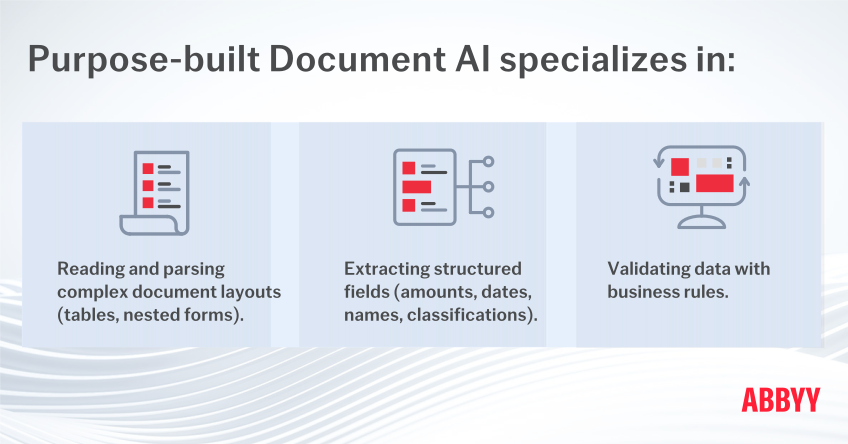
Document AI is changing how businesses process and use the information in contracts. In addition to speeding up contract review, AI-powered automated contract data extraction lets businesses see data clearly and holistically. Benefits include:
- Speed and scalability: Automated extraction can process in minutes what humans take much longer to digest.
- Data-driven decision-making: The structured data from automated extraction lets you analyze and act on accurate information.
- Accuracy: Pre-trained Document AI models can recognize clauses and values across thousands of pages. Businesses receive consistent, high-accuracy results across entire contract portfolios.
- Risk mitigation: Automated validation checks extracted data against business rules and reference databases. Built-in logic can flag obligations and upcoming renewals automatically so risks are caught early and results remain auditable.
- Unstructured handling: Document AI can process contracts in many different formats and multiple languages. Businesses gain consistent visibility and reliable data across documents that manual review could never manage at scale.
Manual vs automated contract extraction
| Features | Manual | Automated |
|---|---|---|
| Cost | High labor costs for skilled reviewers and repetitive data entry | Reduced processing costs through automation |
| Efficiency | Weeks or months required to review large volumes of contracts | Thousands of contracts processed in minutes or hours |
| Accuracy | Prone to human error and inconsistent interpretation | Consistent, audit-ready data |
| Complexity handling | Struggles with variable formats and multilingual content | Processes structured, semi-structured, and unstructured multi-language contracts |
| Compliance and risk | Manual processes lack validation and traceability | Built-in validation and confidence scoring flag issues automatically |
| Scalability | Difficult and expensive to scale as document volumes grow | Scales without adding headcount |
| Integration | Extracted data remains siloed | Structured data can be integrated with ERP, CLM, and other systems |
How Document AI and LLMs work together for contract automation
Document AI isn’t the only tool that can help businesses process contracts. LLMs can also be useful, so long as they work alongside Document AI.
While general-purpose LLMs offer a wide range of capabilities, they aren’t built specifically to perform document processing efficiently and precisely. That’s a significant shortcoming for legal and contract workflows, which demand precise, verifiable extraction that holds up to audit.
The most effective approach for contract automation is one that combines the accuracy and accountability of purpose-built document processing models with the flexibility and natural language reasoning of LLMs. Let’s look at the synergies between the two technologies:
Large language models (LLMs)
LLMs are exceptional for exploration, research, and summarization. They can interpret context and generate natural-language summaries of complex agreements to help teams understand contracts faster.
However, LLMs bring with them some well-documented limitations:
- Limited compliance and auditability: LLMs generate text based on probabilities, not precise facts.
- Poor at structured data extraction: LLMs lack document structure awareness, which makes them struggle with extracting consistent values.
- Security and data privacy concerns: Contracts often come with data residency requirements and strict obligations around confidentiality. Sending such sensitive data to public and third-party-hosted LLMs can conflict with those obligations.
- Difficult to validate at scale: LLM outputs can change even with small prompt changes, making it hard to rely on them for repeatable workflows.
To manage these challenges, LLMs need the structure and reliability of Document AI.
AI-powered intelligent document processing (IDP)
Accuracy is where Document AI stands apart. By extracting verifiable data from contracts, the technology provides automation you can trust. Intelligent document processing offers:
- Extraction from unstructured data: Purpose-built Document AI models can identify key clauses and values even in complex, multi-format contracts.
- Pre-trained contract intelligence: Models that are pre-trained specifically for contracts can be put to work right away without complex setups.
- Built-in compliance and scalability: Every field that Document AI extracts from a contract can be traced and verified, with optional human review to meet regulatory needs.
- Transparent, explainable results: Document AI can offer confidence scoring and rule-based validation to make its outputs auditable.
- Data sovereignty and control: Because Document AI processes documents within controlled environments, organizations can extract sensitive contract data without exposing confidential terms or proprietary information to external models.
IDP puts contract data into a structured resource that businesses can actually use. When combined with LLMs, this technology can generate insights like risk alerts and renewal reminders, too.
Industry use cases for automated contract data extraction
.svg)
Automated contract data extraction is changing how organizations manage performance across departments and industries:
Legal
With automation, legal teams across industries are turning static contracts into structured, searchable data. One example is Ashling, a global automation consultancy that helped a major fast-food franchise overhaul how it managed more than 30,000 lease agreements each year. By using Document AI for structured data extraction with generative AI for interpretation and reasoning, Ashling’s team achieved 82% extraction accuracy, capturing over 350 data fields per lease and cutting manual review work equivalent to 20 full-time employees.
Financial services
Banks and financial institutions require precise contract data. Document AI can accurately capture key terms like interest rates and maturity dates. Financial operations teams can also use automation to validate extracted terms against internal policies and regulatory requirements.
Healthcare
Healthcare organizations process thousands of contracts that affect billing accuracy and regulatory compliance. Document AI can extract details like payment terms and reimbursement rates to make sure agreements align with current healthcare regulations and payer requirements. Hospitals and insurers can spot discrepancies faster and free skilled staff from manual review and data entry.
Transportation and logistics
In transportation and logistics, Document AI can capture details like delivery obligations and rate structures, then check them against purchase orders and other records to offer a real-time view of how contracts are performing across the entire supply chain.
How ABBYY Document AI automates contract management with data extraction
ABBYY’s purpose-built Document AI automates contract management by turning unstructured legal text into structured data ready for business use. At the core of this capability is PHOENIX, ABBYY’s portfolio of purpose-built AI models integrated and optimized specifically for document processing.
PHOENIX takes a hybrid approach, combining specialized AI models that bring accuracy and consistency for specific document tasks like pre-trained Lease Agreement and Basic Contract models with generative AI capabilities that can reason across unfamiliar formats. The right technology gets used for the right task.
Because PHOENIX processes both visual and textual elements together, it can interpret documents that include handwriting, complex scripts, unusual layouts, tables, and images. This multimodal understanding gives it a level of precision general-purpose models can’t match. Combined with reasoning tools like LLMs, ABBYY’s technology lets companies use information in contracts to manage risk and make more precise decisions.
To find out how ABBYY Document AI can help with your contracts, get in touch with one of our experts.