
Your documents aren't a problem. Your parser is.
Try FineParser - a modern, containerized deployment model design for AI. No cloud account. Runs on your infrastructure in minutes. Early access is now open.
August 21, 2026
A parser that looks good on benchmarks but fails on your actual documents will corrupt your RAG pipeline at the source. Evaluating a document parser requires testing against realistic, messy document sets; not just clean demos. Gartner predicts a stark reality for AI initiatives: organizations are expected to abandon 60% of AI projects through 2026 due to data that is not AI-ready. This article explores how to benchmark document parsers for production, including the tests most comparisons skip.
Most parser evaluations start with the wrong question. Teams ask, "How accurate is it?", when the question they really need to answer is, "What happens to my pipeline when this parser gets it wrong?"
The answer matters more than most teams realize. According to LlamaIndex's ParseBench benchmark, even the best performing document parsing services today achieve only around 90% content faithfulness on enterprise document pages, which sounds good until you consider the impact of hallucinations and other errors. It means one in ten pages contains a meaningful omission or structural error before a single embedding is generated or a single query is answered.
Poor parsing at the point of ingestion is a primary cause.
The evaluations that precede deployment are where this risk should be identified, not after weeks of incorrect outputs in production. The comparison that matters is not a parser on its best documents against your current parser on your worst documents. A realistic parser evaluation starts with a document set that reflects your actual production corpus, including its difficult cases.
This guide gives you a framework for running an evaluation that actually predicts production performance, rather than one that confirms what a vendor demo was designed to show you.
Jump to:
Why demo accuracy does not predict production performance
What a realistic evaluation document set should include
What to test beyond character-level accuracy
The difference between lab performance and operational performance
What "good enough" misses in production
How to run a fair comparison against your current parser
Demos using clean sample files create false confidence.
Demos with native PDFs, single-column layouts, and well-structured tables deliver conditions where every parser performs well. Your production document corpus almost certainly contains none of those conditions.
The scanned contracts with uneven brightness; the faxed invoices with skewed alignment; the multilingual regulatory filings with mixed scripts: these appear later, in production, not in the evaluation set.
The gap between demo performance and production performance is where retrieval augmented generation (RAG) pipelines break. Bad parsing produces bad chunks. Bad chunks produce weak retrieval. Weak retrieval produces hallucinations that no amount of prompt engineering or model tuning can fix, because the model is reasoning over corrupted evidence, not missing knowledge.
OmniDocBench's research, published at CVPR 2025, confirmed this directly: accuracy scores drop significantly when parsers move from clean benchmark conditions to realistic, diverse document sets. If your evaluation does not replicate your actual document conditions, the scores you collect will not replicate your actual production outcomes.
The documents you use to evaluate a parser should be drawn from the document types typically used day-to-day in your organization. Your test set should include at minimum:
Evaluate how the parser handles structural ambiguity, not just documents with clear, consistent formatting. Without a realistic test set of these document types, your evaluation is measuring demo conditions, not production realities.
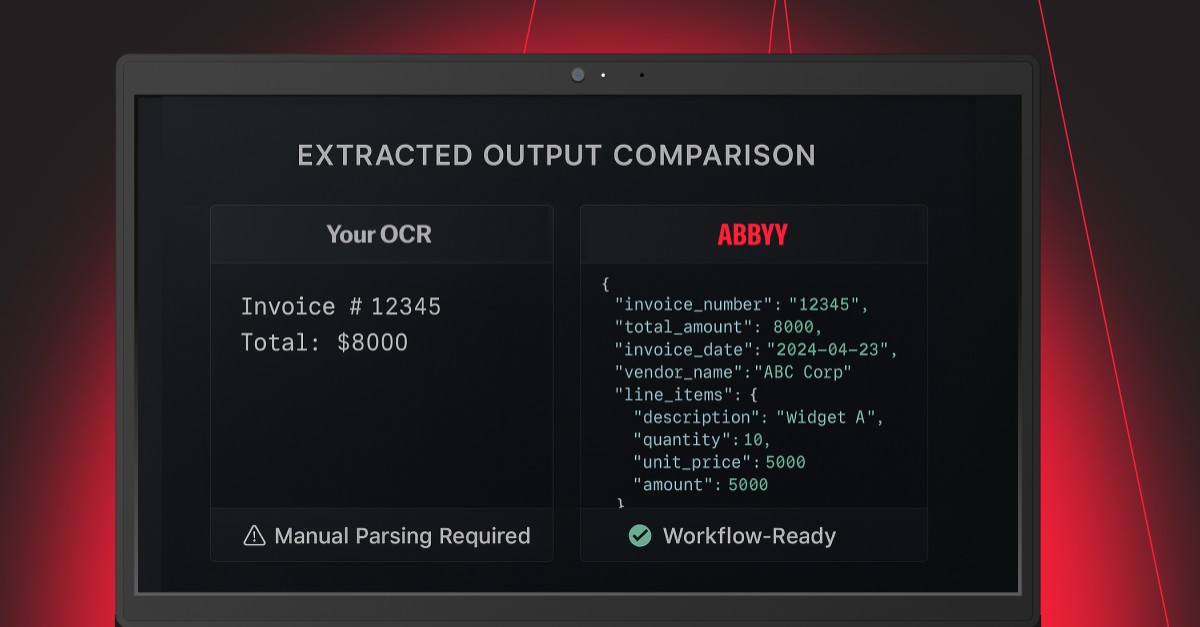
Character-level accuracy, or the percentage of characters correctly extracted, tells you very little about whether a parser will support reliable RAG retrieval. A parser can achieve high character accuracy while completely destroying the information structure your downstream system needs.
Test for each of the following:
A structured format like DocLang, which was co-created by ABBYY with IBM, Nvidia, Red Hat, and the Linux Foundation as an open, AI-native document markup standard, carries semantic labels for headings, paragraphs, table cells, footnotes, and form fields. That structure is what makes output genuinely AI-ready.
Lab performance is what a parser scores on a curated benchmark. Operational performance is what it does on your documents, at your volume, under your constraints.
| Factor | Lab performance | Key difference in operational performance |
| Deployment model | Evaluated in controlled environments, often using high-end hardware such as GPU infrastructure or a cloud API, which is fine for a benchmark run but may not suit regulated environments. | Must function under real-world constraints, such as CPU-only environments or air-gapped networks. |
| Language and script coverage | Typically tested on datasets prioritizing aggregate accuracy across multiple languages. | Requires validation on specific languages or scripts relevant to your document set, including non-Latin scripts. |
| Error consistency | Rarely measured — benchmarks reward average accuracy, not failure behavior. Error consistency may not be a primary focus. | Predictable failure modes are essential for manageability in real usage scenarios. Understand failure patterns to ensure consistent performance. |
| Processing speed at scale | Performance is assessed with individual, or small-scale document sets. | Measured under actual workload conditions, not just single documents, ensuring scalability with high document volumes. |
The most effective parsers are those that produce efficient, predictable data structure across diverse document types, and that evaluation needs to go beyond plain OCR accuracy to measure semantic understanding.
There is a category of evaluation outcome that causes real problems: "good enough on most documents."
The question is not whether your parser handles clean documents well; it is whether it handles your corpus whether it can reliably process your corpus without introducing errors that propagate downstream through the pipeline.
"Good enough" misses the compounding effect of partial errors. A parser that extracts 98% of a document's content correctly but consistently flattens all tables may produce usable output for most queries while completely failing on any query that requires table data. The 98% aggregate accuracy number does not capture the 100% failure rate on table-dependent queries.
If those errors involve key financial terms, dates, or liability clauses, the downstream consequences are not abstract.
This is why evaluating specifically on the document types and structural features matters most for your use case. If your pipeline depends on table extraction, evaluate table fidelity specifically. If you process multilingual documents, evaluate per-language accuracy. If you depend on section hierarchy for chunking, evaluate whether section boundaries are correctly identified.
The hard documents reveal the ceiling.
A direct comparison gives you the most actionable signal. Run the same document set through your current parser and through the parser you are evaluating, then compare outputs side by side on the dimensions that matter for your pipeline.
Specifically:
The goal is not to find a parser that scores higher on a leaderboard. The goal is to find a parser that produces better outcomes in your specific pipeline, on your specific documents.
The fastest way to understand a parser's production ceiling is to give it your most challenging documents first. The ones that currently cause problems in your pipeline. The ones that produce hallucinations, broken tables, or garbled reading order.
With FineParser powered by ABBYY, you can pull the Docker container, run it on the documents that are already causing problems, and compare the structured output against what your current parser produces.
The difference between what your parser returns and what a structure-preserving parser returns will tell you more about your pipeline's reliability ceiling than any benchmark score.
Test ABBYY on your real-world documents, early access is now open.
To handle large document volumes effectively, implement a message queuing system with distributed computing. ABBYY's FineReader Engine and FineParser support Docker deployments across private cloud and on-premise infrastructure, enabling automatic scaling.
The highest-risk document types are multi-column layouts, tables with merged or borderless cells, scanned documents with noise or skew, long documents where structure spans multiple pages, and documents containing non-Latin scripts. These conditions cause most parsers to produce structurally incorrect output that corrupts downstream chunking and retrieval.
Parsing quality sets the accuracy floor for every downstream stage in a RAG pipeline. When a parser produces incorrect reading order, flattened tables, or dropped content, the chunks derived from that output carry corrupted evidence. The model then generates confident answers based on incorrect context, which mimics hallucination caused by knowledge gaps but originates at the ingestion layer. Fixing the parser removes a primary source of hallucination without changing the retrieval strategy or model.
For RAG and agentic AI workflows, structured semantic formats are essential. Plain Markdown and raw text strip the structural information that makes retrieval reliable. Formats like DocLang carry semantic labels for every content element, including headings, paragraphs, table cells with their row and column positions, footnotes, and form fields. DocLang is an open standard co-created by ABBYY, IBM, Nvidia, Red Hat, and the Linux Foundation, designed specifically for AI document consumption. JSON, ALTO, and XML with semantic labeling also preserve structure that supports accurate chunking and retrieval.
For simple, single-column, native-text PDFs, a lightweight parser may be sufficient. For any corpus that includes scanned documents, multi-column layouts, tables, or multilingual content, open-source tools like Tesseract impose an accuracy ceiling that directly limits retrieval quality. Open-source tools typically perform considerably below that ceiling on realistic enterprise document sets. Investing in purpose-built, enterprise-grade solutions ensures better performance, maintenance, and alignment with long-term goals.
Deployment models that fit production reality, like FineParser, offer a complete document-fidelity stack in one container: structure, tables, layout and text, no microservice sprawl, no external calls.
FineParser is a modern, containerized deployment model designed for AI, see how it works.
A meaningful evaluation requires at least 50–100 documents drawn from your actual corpus, weighted toward your most complex and problematic document types. Testing on fewer documents, or on documents that are cleaner than your production average, will produce accuracy scores that do not predict production outcomes. The documents that currently cause problems in your pipeline should be the starting point for any evaluation, not the clean examples.
Table fidelity is often the most revealing test, because it is the structural feature that most parsers handle worst and that matters most for downstream accuracy. Evaluate whether row-and-column relationships are preserved, not just whether table content appears in the output.
There is no one-size-fits-all document parser for Retrieval-Augmented Generation (RAG). The best parser depends on factors like your data formats, processing needs, and scalability requirements. The right question isn't "which is best," but "which performs best on my documents, at my scale, under my constraints." Test FineParser on your real-world documents. Parse in your language of choice, run on your infrastructure in minutes. Get early access to the document parser built for teams that own their stack.

Dr. Marlene Wolfgruber
Director of AI Strategy at ABBYY
Dr. Marlene Wolfgruber brings over 10 years of leadership experience in product management and product marketing. She has deep knowledge in a wide range of topics within the intelligent automation industry, and regularly shares her expertise as an expert in AI and language technologies. In her previous roles, Marlene led efforts to revolutionize AI-powered spend management and empowered businesses to build autonomous assistants with generative AI. She holds a Ph.D. in computational linguistics from Ludwig Maximilian University of Munich, and enjoys reading, exercising, cooking, and spending time with her two children.
For keen insights, follow Dr. Marlene Wolfgruber on LinkedIn.
Co-hosted by Marlene and Max of ABBYY, the AI Pulse Podcast covers a wide range of topics for business and technology leaders with a focus on how AI is reshaping how we work. Tune in wherever you get your podcasts. Available on YouTube, Spotify, and Apple Podcasts.
Please enjoy! https://linktr.ee/AIPulsePodcast