
Real-world documents rarely arrive as clean datasets. They aren’t pristine records so much as living operational artifacts, shaped by everything from regional standards to human workflows. Handwritten annotations may overlay printed text, or key fields shift positions depending on the vendor. Low-quality scans, multi-language files, and embedded tables that disrupt layout logic are routine realities in enterprise document processing.
Modern intelligent document processing (IDP) solutions can handle such complexity at scale. But in enterprise environments, automation must also be controllable and adaptable. To work in the real world, automation needs to fit into existing governance standards and control frameworks.
That’s why leading Document AI solutions integrate human-in-the-loop (HITL) workflows by design. The human layer acts as a built-in control point that adds transparency and governance to make automation adjustable and accountable without slowing it down.
Jump to:
What is human-in-the-loop with AI?
How Document AI with HITL balances automation and control
How HITL helps Document AI adapt and scale
How human-in-the-loop works for AI document processing
HITL layer must be purpose-built for documents
Common misconceptions about human-in-the-loop AI
What is human-in-the-loop with AI?
Human-in-the-Loop AI is an approach where humans participate in AI-driven workflows. AI automates tasks, while humans handle exceptions and validate critical decisions.
AI with HITL combines automated document processing with structured human review based on set business rules.
The AI performs classification, extraction, and validation automatically, based on defined thresholds that reflect the organization’s risk tolerance. Automation remains the primary decision-maker. Only when risk thresholds are exceeded, or business rules not met, are cases routed to humans for review.
Human decisions are then captured and fed back into the system, so the AI model adapts to operational needs as they evolve.
Essentially, HITL functions as a control layer that keeps systems operating within agreed boundaries while still maintaining high efficiency and accuracy.
How Document AI with HITL balances automation and control
In enterprise environments, document automation has to work in steps with compliance processes and regulated approval chains. Defined policies, risk tolerances, and confidence thresholds determine which documents proceed automatically and which require review. Some workflows with compliance-sensitive data, for example, require mandatory review steps to meet regulatory requirements.
That distinction is what separates basic automation and enterprise-grade automation. Enterprise businesses need the ability to set acceptable confidence levels and review triggers for human validation.
HITL makes that possible. Most documents move straight through automated systems, but those that don’t meet predefined thresholds are routed for review. Every decision, whether automated or manual, is logged to create a clear record of how data was validated.
Ultimately, HITL gives enterprises granular control over their automation systems to account for organization-specific risk tolerance and compliance standards while still preserving speed and scale.
How HITL helps Document AI adapt and scale
Continuous learning
Each time a human confirms or adjusts extracted fields, the system learns from those decisions and applies that learning to similar documents going forward. Over time, the system becomes increasingly optimized for your specific document landscape, with higher straight-through processing rates.
Real-time exception handling and rework reduction
Most documents move automatically, but when predefined rules are triggered, those exceptions are routed for review and resolved in context at the point of processing before the data moves downstream.
Auditability and compliance
Since both automated and human actions are recorded, teams get clear and defensible audit trails that detail what was extracted and what was reviewed.
Increased stakeholder trust
Enterprise leaders get control over automation and visibility into how automation performs in production, including exception rates and validation outcomes. This visibility helps organizations decide where automation can scale across teams and workflows.
Accelerated review cycles
By addressing cases that trigger rule-based review during processing, teams can avoid delays and rework during downstream approvals or reporting.
How human-in-the-loop works for AI document processing
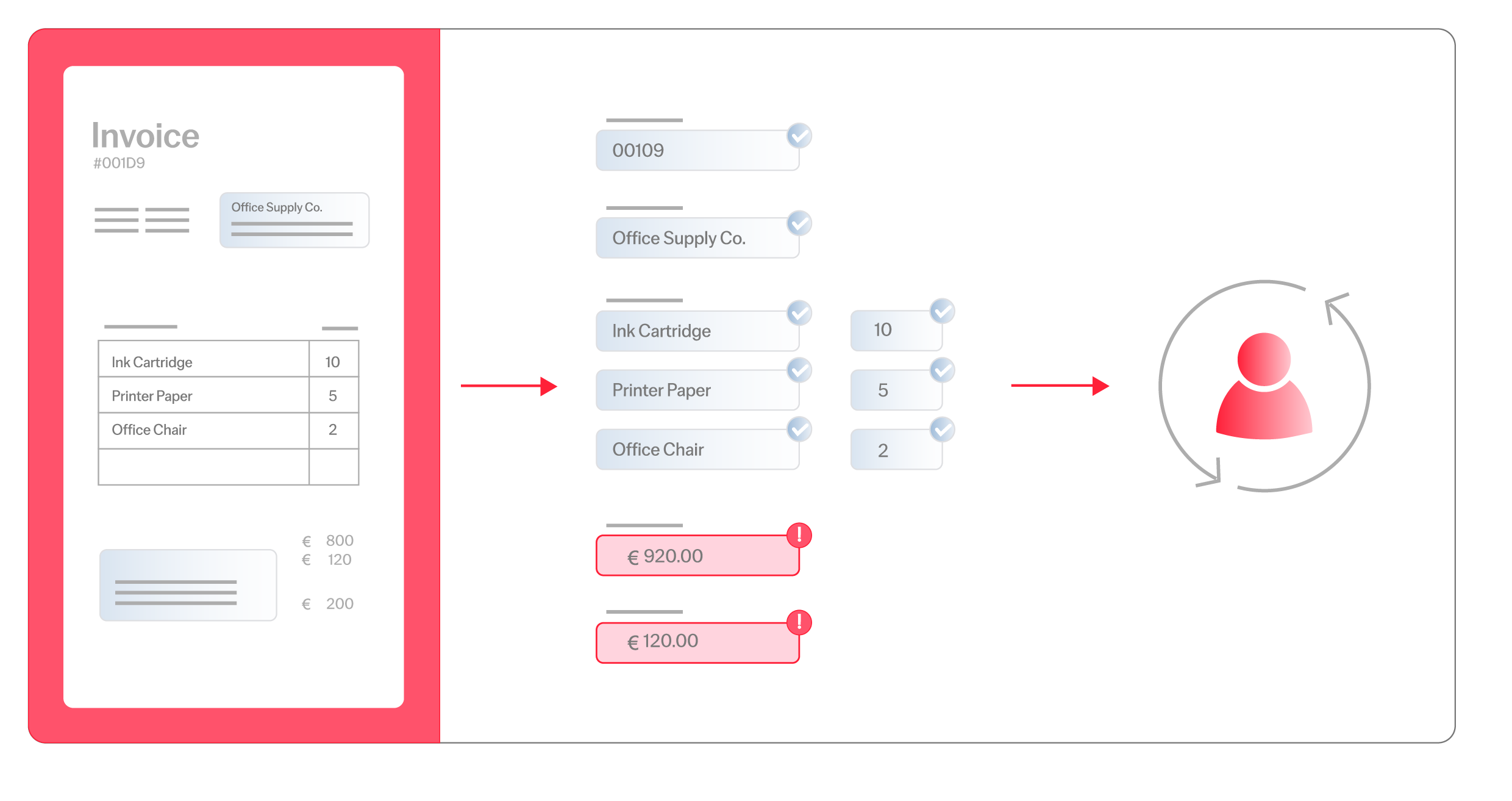
In modern Document AI workflows, automation remains primary, but human oversight comes in strategically and selectively.
-
Step 1: Document capture
Business documents enter a Document AI solution. -
Step 2: Automated analysis
Document AI extracts and classifies information from the documents, applying validation rules automatically. Data proceeds directly into downstream systems unless predefined rules are triggered for data that require further review. -
Step 3: Human intervention
Flagged data is sent to the appropriate reviewer to look over in context, using purpose-built verification interfaces. -
Step 4: Feedback loop
Human decisions are fed back into the system to improve how the AI handles similar cases in the future. Over time, this feedback loop optimizes alignment with enterprise policy frameworks and expands automation capabilities.
HITL layer must be purpose-built for documents
HITL verification systems vary quite a bit in terms of their capabilities. Generic HITL tools, for example, often perform simple data labeling or model review quite well, but struggle with complex or varied documents that include multiple layouts or mix in tables and images with printed and handwritten text.
For such work, you need HITL systems that are purpose-built with business documents in mind. ABBYY’s HITL approach is designed specifically for Document AI, with advanced verification tools trained on how documents are structured and used in business processes.
More importantly, ABBYY HITL has configurable review triggers and field-level rule enforcement that give organizations measurable control over their automation strategy, even across distributed teams. Because HITL is built directly into the Document AI platform, governance controls don’t require separate tools or manual workarounds. Subject matter experts are able to review extracted data in context for fast, reliable validation.
ABBYY also provides enterprise-grade capabilities like built-in analytics that let you see how accurately your Document AI solution is performing and what your exception rates look like over time. The HITL layer is embedded within and integral to the Document AI solution and is designed to scale with the volume and variability of real business documents.
Common misconceptions about human-in-the-loop AI
-
HITL slows down tasks.
Poorly implemented review processes can create bottlenecks, but purpose-built HITL systems are structured to avoid them. When review rules are configured for your documents and workflows, humans review only defined exceptions, preventing policy misalignment and rework that can cause downstream delays. -
HITL increases manual work.
Document AI systems route the vast majority of routine documents automatically. Only defined exceptions are routed for HITL review, and over time, human involvement becomes even more focused as automation adapts to changing document patterns and exception rates decline. -
HITL means AI isn’t accurate or smart enough.
High-performing Document AI systems already process most documents automatically and accurately. The exceptions that get routed for human review arise not because automation lacks accuracy or intelligence, but rather because enterprise workflows require defined review paths for certain decisions, regardless of accuracy. -
HITL is expensive.
In enterprise environments, costs are significantly lower when decisions are validated against internal and regulatory policy at the point of processing. HITL acts as a cost-control mechanism that reduces compliance failures or audit remediation.
Best practices for human-in-the-loop success
-
Define validation thresholds clearly
Set review triggers based on real compliance and financial risks your organization faces, with clear rules for what gets approved automatically and what gets flagged for human review. -
Monitor automation metrics continuously
Track straight-through processing and accuracy trends. Assess exception rates to monitor performance and detect format shifts or emerging edge cases. -
Standardize reviewer decision options
Give reviewers defined criteria or scoring categories so they can quickly provide structured, consistent feedback. -
Establish governance transparency
Make human review an explicit part of your enterprise control framework, with documented roles and processes, to make oversight auditable.
ABBYY Document AI: Automation with Built-In HITL Governance
Enterprise document automation must balance scale, speed, and control. That’s why HITL verification is a core capability of ABBYY Document AI.
AI handles the bulk of document processing automatically, while exceptions are routed intelligently based on defined validation thresholds. Human expertise strengthens performance over time.
Every human decision feeds directly back into the Document AI solution, and this continuous learning improves extraction accuracy, reduces exceptions, and increases straight-through processing over time. Combined with built-in quality analytics, this approach makes for document automation that’s enterprise-ready by design.
See what ABBYY Document AI and built-in HITL verification can do for your document workflows.