September 29, 2026
PHOENIX Plus is now available for ABBYY Vantage: a native GenAI capability that lets you augment traditional intelligent document processing (IDP) capabilities with the flexibility and reasoning power of generative AI, all within a trusted IDP pipeline. You maintain full control over output reliability, provenance, traceability, explainability, and auditability.
PHOENIX Plus runs on models that ABBYY selects and optimizes specifically for documents, backed by our decades of expertise in extraction, edge cases, and enterprise-grade production requirements.
Jump to:
How to Integrate Generative AI into Your Document Processing Pipeline (Demo)
The hybrid approach: Expanding automation without abandoning reliability
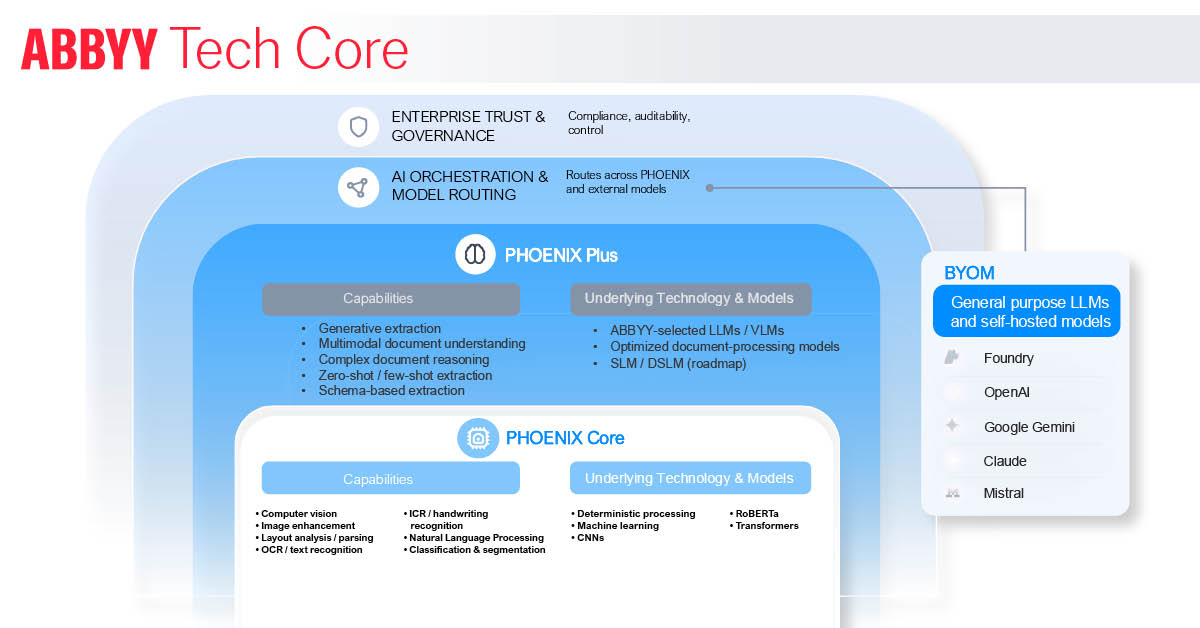
PHOENIX is ABBYY's portfolio of proprietary and selected AI technologies, spanning deterministic and generative AI. ABBYY optimizes these technologies for reliable, high-performance document processing in enterprise production environments.
PHOENIX Core builds the foundation of ABBYY's purpose-built Document AI: decades of experience in understanding and processing documents, covering structure, layout, optical character recognition (OCR), classification, extraction, and the document-specific intelligence underneath every workflow.
PHOENIX Plus sits on top: ABBYY's native GenAI capability, powered by models ABBYY selects, optimizes, and manages for document processing. You choose where GenAI adds value in your workflow without having to evaluate, select, or manage the underlying foundation model yourself.
| Advantage | Why it matters |
| Purpose-built for documents | Models are selected, customized, and fine-tuned specifically for document understanding and processing, rather than general-purpose AI use. |
| Ready-to-use prompts | Pre-engineered prompts provide the structure and rigor LLMs need to work reliably with factual document content, reducing the effort required to design and test prompts from scratch. |
| Built for production workflows | PHOENIX Plus operates within the Vantage IDP pipeline, with enterprise-grade capabilities such as data validation rules, human-in-the-loop workflows, and traceability built into the process. |
| ABBYY-hosted | Your data is processed within ABBYY's hosting environment, in the same region as your Vantage data, and is not retained after the result is returned. With BYOM, data is sent to the model endpoint you configure and handled under that provider's terms. |
| Predictable cost | No separate model-vendor contract, infrastructure provision, or token-based billing to manage. PHOENIX Plus is added to your Vantage subscription at a fixed annual cost. |
| Built on a proven foundation | PHOENIX Plus augments PHOENIX Core's deterministic Document AI with generative AI, delivering ABBYY's hybrid approach in practice. |
PHOENIX Plus is designed to work as part of a hybrid Document AI process. What that means in practice: Use deterministic and pre-trained AI where they already perform well, and bring in GenAI where flexibility, visual understanding, or reasoning adds value.
When you need to process new document types without training a dedicated skill first, PHOENIX Plus can extract from ABBYY's structured OCR output using prompts.
Rather than sending an unprocessed document directly to a large language model (LLM), Vantage first turns it into machine-readable content and document structure. PHOENIX Plus can then focus on understanding and extracting the information you need.
Best for: unseen documents, long-tail document types, and highly variable layouts where creating or retraining a dedicated skill is not practical.
If a pre-trained or custom skill already handles most of the document reliably, keep it.
Use PHOENIX Plus selectively for fields or content that benefit from GenAI, such as highly variable information, free-form text, stamps, or signatures.
This keeps predictable extraction deterministic, while using GenAI for the harder parts.
OCR and structured text should be the primary input. Add page images when the information itself is visual, such as stamps, signatures, or photographs.
Doing that avoids asking the LLM to interpret the entire page visually when the document structure is already available.
PHOENIX Plus can work on data that Vantage has already extracted and validated, adding context that goes beyond the fields captured from the document.
This can include interpreting clauses or free-form text, deriving categories or classifications, identifying inconsistencies, comparing related information, analyzing the information in context, or generating recommendations to support downstream decisions.
The result is not just extracted data, but richer information that can support automation and decision-making.
Reliable GenAI in production requires more than a good prompt. Define what the model should do, what it should not infer, and what output you expect. Then apply validation, business rules, confidence thresholds, and human review where needed before that output moves further into the process.
These controls are not optional safeguards around GenAI. They are what makes it practical to use GenAI in business-critical document processes. By running GenAI through the IDP pipeline, you can combine its flexibility and reasoning capabilities with the structure, validation, traceability, and control required for production automation.
That is the foundation of the hybrid approach: use GenAI where it adds value, but surround it with the Document AI capabilities needed to make its output reliable and actionable.
The best practice is not to force a single technology across every task. It is to deploy the right capability for each step: deterministic Document AI where precision and consistency are non-negotiable, and GenAI where flexibility, interpretation, and reasoning deliver the most value.
Deterministic processing provides the structure, precision, consistency, and controls that production document workflows depend on. GenAI adds flexibility where documents vary, interpretation is required, or the task calls for analysis and reasoning.
Bringing the two together lets you use GenAI without asking it to do everything. OCR, parsing, extraction, validation, and structured output provide a reliable foundation, while GenAI is applied where its ability to interpret, adapt, and reason adds value.
This is how the hybrid approach gives you greater flexibility without giving up the reliability and control required for enterprise automation.
If your organization is managing a growing variety of document types, dealing with slow model training cycles, or looking to reduce the manual effort in HITL review, PHOENIX Plus is worth exploring now.
For access to PHOENIX Plus: Contact your ABBYY account team to learn whether your use case qualifies for the current controlled release program.
To explore the ABBYY Document AI platform: Visit abbyy.com/ai-document-processing or the ABBYY Marketplace to see the full portfolio of pre-trained extraction models and integration options.
To stay current with the "Feature Spotlight" series: Visit the ABBYY blog for all the latest "feature spotlights".
PHOENIX Plus is ABBYY's native generative AI capability for the ABBYY Document AI platform (Vantage). ABBYY selects, optimizes, and manages the underlying models specifically for document processing. You consume the capability and its outputs without needing to evaluate, select, or maintain the foundation model yourself.
With BYOM, you connect a third-party LLM of your choice, such as OpenAI, Google Gemini, Anthropic Claude, or Mistral, through the prompt-based activity. You control the model selection and manage the provider relationship. With PHOENIX Plus, ABBYY manages the model end-to-end: hosting, optimization, and quality. Your data stays within ABBYY's hosting environment and is not retained after results are returned.
Production-ready GenAI means the model operates inside a governed IDP pipeline, not as a standalone tool. PHOENIX Plus works within Vantage's document processing workflow, alongside deterministic extraction, validation rules, confidence scoring, human-in-the-loop review, and full traceability back to the source document. That structure is what makes GenAI outputs reliable and auditable in real business processes.
Zero-shot extraction lets PHOENIX Plus extract structured data from document types it has not been trained on, using prompts to define the output schema rather than labeled training data. It is best suited for unseen documents, long-tail document types, and highly variable layouts where building or retraining a dedicated skill is not practical or cost-effective.
No. PHOENIX Plus extends ABBYY's hybrid approach rather than replacing it. Where a pre-trained or custom skill already performs well, you keep it. PHOENIX Plus applies where greater flexibility is needed, such as highly variable fields, unstructured text, or document types without an existing training set. The goal is to use the right technology for each task.
PHOENIX Plus runs within ABBYY's hosting environment, in the same region as your Vantage data. ABBYY does not retain document content or model responses after the result is returned to Vantage. Content processed through PHOENIX Plus is not shared with other customers or used to train external foundation models without your explicit permission.
PHOENIX Plus is well suited for documents with variable layouts, unstructured content, or complex free-form text that deterministic extraction alone cannot handle reliably. Applicable use cases span financial services (loan applications, financial statements, KYC documents), healthcare (clinical notes, insurance claims), logistics (bills of lading, customs documents), and legal or compliance-critical workflows requiring both flexibility and auditability.
Yes. ABBYY Vantage supports BYOM, which allows organizations to connect and control their own large language model within the platform.
Supported model providers include Anthropic, Google AI Studio (Gemini), Microsoft Foundry, Mistral AI, or OpenAI ChatGPT. PHOENIX Plus serves as ABBYY's managed GenAI option for teams that prefer a fully optimized, production-ready path without managing a foundation model themselves. Both options integrate into the same Vantage pipeline, giving organizations the flexibility to choose the approach that best fits their infrastructure, compliance requirements, and operational preferences.

Slavena Hristova
Director of Product Marketing, Document AI at ABBYY
Slavena Hristova is a seasoned product marketing leader specializing in AI-powered intelligent document processing, OCR, and business process automation. As Director of Product Marketing at ABBYY, she drives the global strategy for the Document AI product line, shaping its market positioning, go-to-market execution, and customer adoption.
With deep expertise in product marketing and management, Slavena bridges the gap between technology and business needs, enabling organizations to harness AI-driven automation for smarter document workflows. Passionate about innovation and the evolving role of AI in enterprise automation, she brings a strategic and results-driven approach to transforming how businesses process and extract value from their data.
Follow Slavena on LinkedIn.
