You can learn a lot about a person by reading their health records: family history, bones broken and healed, treatments endured. Imagine if AI could go through decades of a patient’s information in an instant and help support the people delivering care.
The trouble is, much of medicine is recorded in unstructured documents like scans and clinical notes. These files contain the context clinicians rely on, but general-purpose large language models (LLMs) often can’t interpret them accurately. They miss important details or simply guess, producing hallucinations.
This limitation is what retrieval-augmented generation (RAG) is meant to solve. Here’s a closer look at what RAG is, why it matters in healthcare, what benefits and challenges it brings, and how it can fit into real clinical workflows.
Jump to:
What is RAG, and how is it used with LLMs in healthcare?
Core components of a healthcare RAG system
The benefits of RAG for healthcare organizations
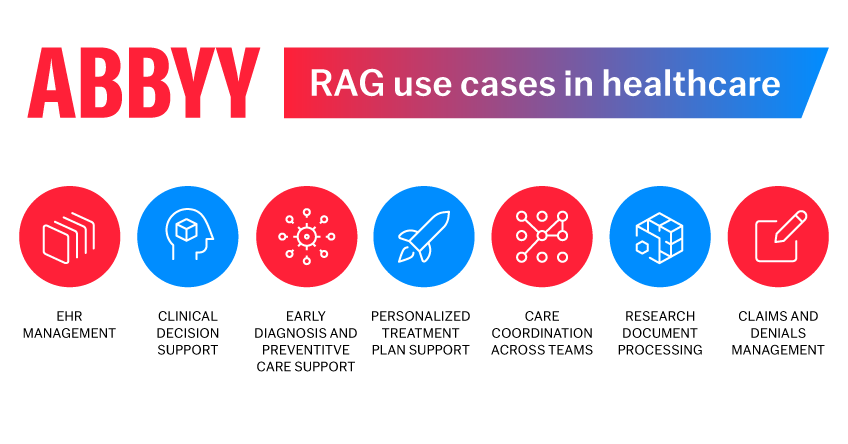
Real-world use cases for healthcare RAG
Key challenges to address for successful RAG in healthcare
What is RAG, and how is it used with LLMs in healthcare?
At its simplest, RAG is a process that connects LLMs to information from outside sources. Instead of relying only on just the data LLMs were trained on, RAG lets these models pull in current, verifiable facts to provide more timely and accurate answers.
That capability matters in healthcare, since medical information changes constantly. An AI system that can’t access fresh data risks offering outdated or incomplete answers. With RAG, the model can consult a library of medical texts or institutional knowledge to provide a more precise response.
In healthcare, RAG makes LLMs more reliable by:
- Keeping information up-to-date: RAG connects the LLM to the latest facts.
- Reducing hallucinations: RAG helps to reduce hallucinations by grounding its responses in facts from real documents.
- Personalizing treatments: With access to a patient’s records, RAG can support clinicians in tailoring recommendations and provide relevant context to inform decisions.
Core components of a healthcare RAG system
Building a reliable RAG system in healthcare starts with high-quality data. In document-heavy healthcare environments, RAG systems benefit significantly from Document AI, which transforms document content into clean, structured data.
Here’s what the RAG tech stack looks like and how the process typically works.
- Document AI: First, healthcare information contained in unstructured documents like doctors’ notes, patient emails, labs, and x-rays is loaded into the Document AI solution. Using machine learning and natural language processing (NLP), Document AI reads and understands the structure and content of those files, and when necessary, splits larger files into smaller sections. The data in those files then get digitized, extracted, and organized into structured formats that automation tools can work with.
- Data indexing: Once structured, the content is embedded, meaning they get converted into numerical representations and indexed so the system can quickly identify and retrieve the most relevant information. These embeddings are stored in searchable indexes.
- Retrieval engine: When a clinician or user asks a question, the RAG’s retrieval component searches the indexed data to find up-to-date information on the topic from the organization’s own knowledge base.
- LLM reasoning and generation: The retrieved information is fed into the LLM so it can respond using verified facts from the organization’s own data. This helps the model produce responses that are accurate and appropriate.
- Validation and safety: Before responses are delivered, they can be checked against the original sources for attribution and consistency.
The benefits of RAG for healthcare organizations
Improved clinical decision support
RAG can give LLMs access to the most relevant case histories or treatment evidence at the moment a clinical question is asked. Clinicians can then use this information to better diagnose complex cases and select treatment options.
Unified access across information silos
RAG can surface insights from across electronic health records (EHRs), department files, imaging archives, and research databases, collecting all the relevant information even when it’s scattered across systems.
Higher accuracy
With access to real, validated patient and clinical information, RAG can produce more precise and dependable responses with fewer hallucinations.
More personalized treatments
RAG brings a patient’s history, medications, labs, and prior treatments into the AI’s reasoning. Clinicians can receive individualized summaries and treatment recommendations.
Increased trust and transparency
While LLMs offer little in terms of traceability, RAG supports source attribution, allowing clinicians to trace conclusions back to the exact patient record or reference document used.
Scalable workflows
When paired with Document AI, RAG can reduce clinician workload by summarizing patient histories or creating briefs for care teams from structured data.
More equitable AI outputs
Because RAG grounds its answers in relevant external information sources rather than a fixed training set, it can reflect a wider range of patient experiences if the external data captures that diversity.
Real-world use cases for healthcare RAG