Solving real-world problems with purpose-built AI
How can you ensure intelligent document processing will drive scalable, reliable outcomes? The answer lies in choosing solutions that are purpose-built to address the unique challenges of your industry and operations.
Taking a reality-first approach, ABBYY delivers AI technology specifically developed to handle the nuances of unstructured data, moving beyond the initial proof of concept phase and achieving real impact. By focusing on solutions optimized for specific business areas—such as banking, healthcare, and insurance—you can cut through the noise of overpromising providers. Our targeted solutions go beyond AI theory to manage the complexities of real-world documents and turn once-overwhelming document processing challenges into scalable, predictable outcomes.
To make sure your solution meets these objectives, look for these key factors:
1. GenAI with a laser focus
GenAI holds enormous potential, but its success requires using it right. The right type or types of AI must be used for each task. In IDP, for example, a hybrid approach can be highly effective. ABBYY Document AI employs a refined hybrid of deterministic and generative AI to deliver accurate, consistent, and reliable data extraction from complex, unstructured business documents.
Rather than relying on the “prompt and pray” method of simply hoping a given AI solution will deliver, this focused approach ensures that document processing is grounded in dependable data and enhanced with the reasoning capabilities of LLMs. GenAI's power lies in using the facts extracted reliably from documents to generate output that requires reasoning and creation of new content, such as writing an email that outlines the inconsistencies in a document.
2. Reliable, AI-ready data
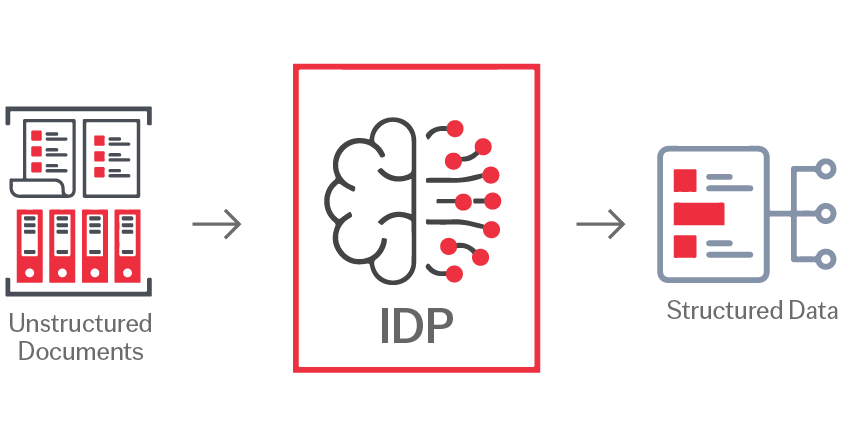
Data without structure is just noise. Yet, unstructured data remains one of the greatest hurdles for automation today. While this data holds the potential to offer powerful insights, the information must first be converted into a usable form.
To achieve their ambitious automation goals, enterprises clearly need solutions that can organize and normalize unstructured data contained in emails, scanned documents, and handwritten notes. Purpose-built tools that integrate optical character recognition (OCR), data extraction, and classification are necessary to turn all that information into reliable, structured data.
Organizations that succeed in AI-powered automation do so by prioritizing solutions that are specifically designed to handle the intricacies of unstructured data—and integrate with downstream systems that can take action on the data. This allows businesses to not only transform vast amounts of information into valuable insights, but immediately put those insights into action.
3. Controlled risk
Choosing the wrong provider or approach to automation can lead to serious consequences. Unproven, experimental solutions often bring instability, undermining automation efforts and potentially derailing strategies. To avoid unnecessary risks, businesses should prioritize solutions with a proven track record of scalability and reliability that provides the automation strategy a strong, dependable foundation.
4. Sustainable pricing
While open-source solutions or LLMs may seem cost-effective at first, they often come with high maintenance and hidden operational expenses. Organizations must evaluate a solution’s total cost of ownership, including ongoing operational costs, and look for predictable pricing and measurable results.
5. Truly autonomous agents
The next frontier of automation is agentic, where AI-driven autonomous agents take on complex decision-making and execution tasks with minimal human intervention. But for autonomous agents and agentic automation to function effectively, they must reliably access and interpret the vast amounts of business data locked within documents. Without a human-like understanding of context, structure, and intent, these agents risk making flawed decisions based on incomplete or erroneous information. Poor data extraction can lead to cascading errors, compounding risks at the scale and speed at which autonomous systems operate. If data is misinterpreted or inconsistently processed, the consequences can be severe—ranging from financial losses to regulatory violations or even operational failures. In a world increasingly driven by AI, achieving true autonomy (and being able to trust it) hinges on the ability to transform unstructured business documents into actionable, AI-ready insights that power intelligent, error-free decision-making.
Tackling industry challenges head-on
Looking ahead, the future of AI in automation will hinge on solutions that are both innovative and tailored to meet specific needs. Purpose-built AI systems that are customized to handle unstructured data are far more effective than generic models because they address the unique, on-the-ground challenges that businesses face. These solutions will serve as the cornerstone of the next generation of automation.
This means businesses that invest in purpose-built solutions crafted for their specific needs now will have a clear advantage in the coming years. These companies will be set up to achieve higher levels of automation, improve decision-making, and better adapt to changing market conditions, giving them a distinct, long-term edge over those relying on one-size-fits-all tools.
