Generative AI and large language models (LLMs) have captured the world's attention with their impressive ability to understand and generate human-like text. Businesses are rightly exploring how this technology can solve challenges, but there's a growing tendency to apply generative AI as a universal solution. This is especially true for processing business documents, a task that demands precision and reliability.
While LLMs are excellent at generation, they were not designed for the high-stakes accuracy required for document data extraction. Relying on them alone for parsing invoices, contracts, or compliance forms can lead to unpredictable and inconsistent results. This doesn't mean LLMs have no role in document automation. When paired with purpose-built intelligent document processing (IDP), LLMs unlock new levels of efficiency, bringing both structure and reasoning to complex workflows. The key is to combine these technologies in a way that amplifies their strengths.
The combination of IDP and LLMs creates a solution far greater than the sum of its parts. IDP technology, like ABBYY Vantage, excels at providing a reliable, factual foundation. It structures data from documents with proven accuracy, which can then be fed to an LLM for deeper analysis. This synergy allows organizations to derive more meaning from their documents with greater confidence.
By grounding a general-purpose LLM in verified document data rather than letting it rely solely on its own generative capabilities, businesses minimize the risk of "hallucinations"—inaccurate or fabricated information. This approach ensures that AI-generated responses remain tied to authentic business information. The LLM can then move beyond simple text extraction to interpret, summarize, and contextualize information in a way that mirrors human understanding. The result is a system that not only reads documents but can also reason with their content, identify patterns, and support decision-making with a verifiable data foundation.
From an implementation perspective, the IDP platform acts as the central orchestration layer. It handles the initial, critical steps of document classification and data extraction using proven, specialized technology. Once this structured data foundation is established, an LLM can be introduced to extend the solution’s analytical capabilities.
Consider a typical workflow: ABBYY Document AI first classifies an incoming document and extracts key information. The workflow logic then determines if that document requires further analysis. This conditional routing is crucial. It ensures that only relevant documents—those needing summarization, contextual interpretation, or risk assessment—are sent to the LLM. This targeted approach optimizes resources and keeps the process efficient.
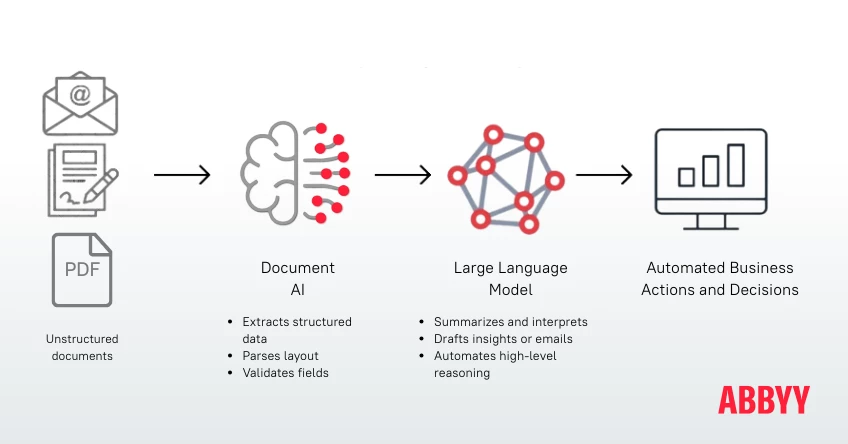
This design pattern can be applied across numerous use cases. The IDP platform always serves as the coordinator, governing when and how the LLM is engaged. This guarantees that the data sent to the model is already of high quality, whether it’s OCR-processed text, structured tables, or specific document sections selected for deeper analysis. The core principle is that the LLM operates on structured, context-limited data. This removes ambiguity, improves consistency, and keeps the model grounded in factual information derived directly from the source documents. When combined with carefully engineered prompts and business rules, this creates a controlled, intelligent system capable of turning raw content into reliable business insight.
Integrating IDP and LLM technologies delivers a solution that moves beyond simple automation to become a system capable of reasoning with data. By anchoring the LLM in verified, structured information from the IDP platform, organizations gain a higher level of confidence in the accuracy of AI-driven insights.
This powerful combination delivers tangible benefits across the enterprise:
From a broader business perspective, this architecture establishes a scalable framework for intelligent automation. It allows enterprises to begin with foundational document understanding and progressively layer on more advanced analytical and cognitive capabilities as their needs evolve. This journey transforms unstructured content into strategic intelligence, setting the stage for continuous improvement through human-in-the-loop learning and process optimization.
To truly harness the combined power of IDP and LLMs, organizations should adopt a strategic approach. A successful strategy focuses on intelligent integration rather than replacing one technology with another.
Start by establishing a trustworthy data layer with an IDP solution to reliably extract facts. Then, use that structured data to empower LLMs for more advanced analysis and summarization. This layered approach ensures your automation workflows are not only fast but also accurate, consistent, and traceable. By building on the solid foundation of IDP, you can confidently extend your automation capabilities with LLMs, turning a potential liability into a powerful competitive advantage.
Get updated on the latest insights and perspectives for business & technology leaders
