

A patient’s treatment gets dangerously delayed because their records are stuck in a processing queue. A compliance team gets hit with a fine because no one flagged the right paperwork in time. These problems often start forming right at the beginning of business processes, when a document arrives, and a decision needs to be made about what it is and where it should go. That decision—document classification is where every document-driven workflow begins, and it shapes everything that follows.
Classification may sound simple, but documents arrive in dozens of formats and languages, and must be read, interpreted, and identified based on content and context before they can be routed to the right place. Automating this process takes intelligent technology that’s purpose-built for the job.
ABBYY’s Document AI, for example, can classify both structured and unstructured content in over 200 languages with both consistency and explainability. Let’s look at what document classification is, how it works, and why it’s an essential step in an intelligent document processing pipeline.
Jump to:
What is document classification?
Approaches to document classification
Benefits of document classification for enterprise operations
How does document classification work?
Document classification use cases
How AI makes enterprise document classification scalable
Intelligent document classification for complex enterprise workflows
What is document classification?
Document classification is the process of identifying and organizing documents by type, then sending each one into the right workflow. It’s the decision layer that determines how document-driven processes begin. When automated, classification technology determines the type of document and routes it to the right data extraction models for further processing.
Approaches to document classification
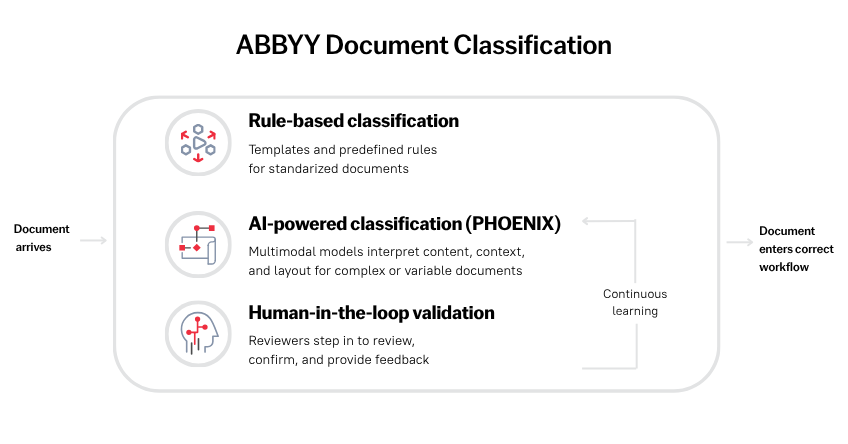
Document classification requires more than single, general-purpose technology. A more specialized framework, one that combines several approaches, is necessary to stay adaptable and precise across the full range of documents that enter your business. The three core approaches are:
-
Rule-based classification:
Relies on predefined rules or templates, such as invoice headers on standardized forms, to identify the type of document. This approach works well when document formats are consistent and predictable. -
AI-powered classification:
Uses purpose-built AI models to identify documents based on context, content, and layout, even in non-standard or unstructured forms. ABBYY Document AI, for instance, is powered by PHOENIX, a portfolio of purpose-built AI models that analyze text and visual elements simultaneously to deliver a deeper level of document understanding than general-purpose large language models (LLMs). -
Human-in-the-loop validation:
Brings in reviewers when business rules require human verification or when the system flags a result for a manual check. That feedback is fed back into the system to make it more accurate over time.
ABBYY Document AI brings all three approaches together into a single hybrid framework. Rules are applied when consistency matters; PHOENIX AI models handle complex or variable content, and human expertise continually improves the system’s accuracy. Rather than choosing one approach over another, enterprises get the right method applied to the right document automatically.
Benefits of document classification for enterprise operations
As the volume and complexity of enterprise information have grown exponentially in the digital age, automating the classification process has become an urgent business need to enhance speed and accuracy in document processing. It’s what allows data to move where it needs to go without delay, and what allows time-sensitive information to surface sooner.
Intelligent document classification gives enterprises:
-
Faster cycle times and higher straight-through processing rates:
Documents automatically reach the right workflow, moving information through the pipeline faster without human intervention. -
Lower cost per document:
Automation reduces the manual effort and human deliberation time that drives processing costs. -
Better organization and searchability:
Each document is automatically identified and routed to the correct workflow or system, making it easier to find and act on later. -
Improved accuracy:
Consistent, automated classification minimizes the chance of human error or misplaced information. -
Reduced compliance risk:
Documents are processed and stored according to defined rules, making them easily traceable for audits. -
Higher productivity:
Employees are freed from repetitive sorting tasks and can instead focus on more value-driven work. -
Continuous learning:
Human-in-the-loop feedback continuously teaches automated classification to become even more accurate over time.
How does document classification work?
Step 1: Define your classification strategy.
Identify the types of documents that enter your business. For those that come in standardized, predictable formats, rule-based classification that applies to predefined templates and criteria will be most appropriate. For more complex or variable documents, prepare examples you can use to train the AI models.
Step 2: Train the model.
ABBYY’s PHOENIX technology analyzes both the text and layout of example documents, identifying the key features that make each one unique. Those features become the foundation for accurate classification. You can optimize the model by defining the balance between high recall and high precision and using built-in data validation tools to test the quality of the model.
Step 3: Classify, route, and refine.
Each incoming document gets a probability or confidence score that determines whether it’s automatically routed to the next step or flagged for human review. That human feedback is then fed back into the system to continuously improve accuracy.
Document classification use cases
The faster you can identify what a document is, the faster you can act on it. This puts document classification at the center of many enterprise workflows, no matter the industry.
Healthcare
A single patient’s electronic health record (EHR) can run hundreds of pages long. By automatically classifying documents that hold EHR data, healthcare institutions can update patient charts much faster while freeing healthcare providers from administrative work.
The global science company 3M, for example, integrated ABBYY Document AI into its health information systems (HIS) to extend the capabilities of the 3M 360 Encompass software suite. The solution now incorporates text recognition for scanned documents, so diagnostic reports, surgical notes, discharge summaries, and other documents can be automatically given standardized codes to streamline billing workflows.
Banking and financial services
Financial institutions often need to check document sets for loan and credit applications, especially for compliance purposes. Automated document classification can be used to identify each document in a submission set, capture key data with fewer errors, verify it against predefined criteria, and route it for approval quickly.
Human resources
Document classification helps HR teams automatically organize and manage employee records, applicant resumes, contracts, and other documents that require archiving in large document repositories. Automating this process makes it much easier to efficiently search and locate information needed for workforce planning and other HR functions.
Government and public sector
Many public agencies receive heavy volumes of correspondence, especially during peak periods. Document classification helps route all this information to the right workflows. The technology can also be used to migrate data and content when agencies modernize records or information systems.
How AI makes enterprise document classification scalable
Before AI, document classification was entirely rule-based, with defined templates and criteria. Documents had to be consistent in format and layout for the rules to hold.
In practice, however, documents vary widely. Using a rules-based system on its own, every variation in layout or format—and every change in regulation or process that required document changes—required teams to reconfigure the classification rules.
As document types multiplied with the digital age to include scanned PDFs, digital forms, emails, mobile uploads, and more, the sheer variety outpaced what any set of predefined rules could handle on its own.
Rule-based classification still plays an important role, being highly effective for precision and consistency when documents are standardized. But today, you can layer on AI that can interpret content, context, and layout together to understand documents more like a human would. With a third layer—human-in-the-loop validation—reviewers step in only when human confirmation or input is necessary and feed their expertise back into the system so it keeps improving automatically.
This is the hybrid approach that ABBYY uses to achieve a level of accuracy and relevance—along with enterprise-grade explainability, transparency, and consistency—that general-purpose LLMs can’t match for document processing. Together, rule-based logic, purpose-built AI, and continuous human feedback provide a classification framework that scales even as documents and business processes grow more complex.
Intelligent document classification for complex enterprise workflows
Documents keep getting more complex and varied. Contracts and correspondence flow in from dozens of digital channels, and the basic tools once built to manage them can’t handle this volume.
ABBYY Document AI can classify any type of document to keep vital information from getting lost in the noise. Unlike general-purpose AI systems adapted to process documents, its technology developed from the ground up for document processing, applying the right model to the right task. Powered by PHOENIX, our purpose-built AI foundation, our systems read and understand your documents at an enterprise scale. This intelligence lets you automate end-to-end processes for all your documents.
That means the results you get are accurate, explainable, and consistent for your critical workflows. And because these capabilities are built on a unified technology layer, process improvements flow across the full ABBYY Document AI portfolio: Vantage, FlexiCapture, and FineReader Engine—as the platform evolves.
Connect with one of our experts to explore how ABBYY can help you automate intelligently.