
In the hands of bad actors, AI can accelerate fraud at a scale humans alone can't match. In the hands of financial institutions, it's the most powerful countermeasure available. But effective defense means deploying AI in the right combination: structured logic that enforces known requirements with consistency and auditability, alongside adaptive models that surface emerging patterns no fixed ruleset could anticipate.
That layered approach is what separates reactive compliance from genuinely resilient KYC. Remember when seeing was believing? “Pics or it didn’t happen” was the standard response to bold claims made online. A photo or video was treated as proof.
Today, that assumption no longer holds. AI has fundamentally changed what's possible: both in how fraud is attempted and how it's detected. The question is no longer just 'is this real?' but 'are we using the right tools to find out?
This shift has implications far beyond social media, changing how financial organizations think about trust and guard against fraud. When AI is exploited for fraud, it enables attacks that are automated, systematized, and highly scalable. Countering that requires technologies, including AI, working just as hard on the other side of the equation. To fight it, Know Your Customer (KYC) processes need to be just as evolved.
Jump to:
How to know what’s real
AI has forced financial institutions to rethink what KYC is actually designed to do. Increasingly, KYC is becoming less about completing verification steps and more about noticing changing risk over time as new information emerges. This is why many organizations are now building KYC solutions around Document AI and process intelligence to gain real-time process visibility and monitoring.
For decades, KYC was built around verifying identity. Now KYC must focus on whether the underlying identities themselves—and the documents and activities tied to them—are authentic and trustworthy. Only by rethinking how trust is established can organizations keep pace with a fraud environment that no longer stands still.
When proof can be fabricated
Traditional KYC frameworks were designed for a world where documents could generally be accepted as reliable evidence of identity and intent. Financial organizations required—and still require—a wide range of documents: IDs, utility bills, tax forms, corporate records. The assumption is that these documents serve as adequate proof of identity, address, financial activity, and legitimacy.
Yet financial criminals today can manipulate documents and doctor photos at breakneck speed. Synthetic identities can be cobbled together from a mix of real and made-up information to make them harder to detect. AI-created documents with convincing metadata can look legitimate to experienced human reviewers.
In fact, documents themselves can be a key piece of fraudsters’ attack strategies, and as such, must now be treated as potential carriers of risk.
Financial crime at machine scale
Machine-generated fraud is also continuously adaptive, growing ever faster and more sophisticated. This requires verification approaches that can accurately judge authenticity by matching the information in documents to broader patterns of customer behavior and risk.
Verification has to be continuous, because increasingly, fraudsters play the long game. An account may appear legitimate during onboarding and remain so for a period of time before false information or suspicious activity appears. There’s no longer a safe zone or period where authenticity can be taken for granted.
In this environment, static KYC frameworks that rely on one-time snapshots or periodic reviews don’t suffice. Financial institutions must be able to continuously verify customer identities and activities over time, watching for threats that appear at any time.
KYC made continuous
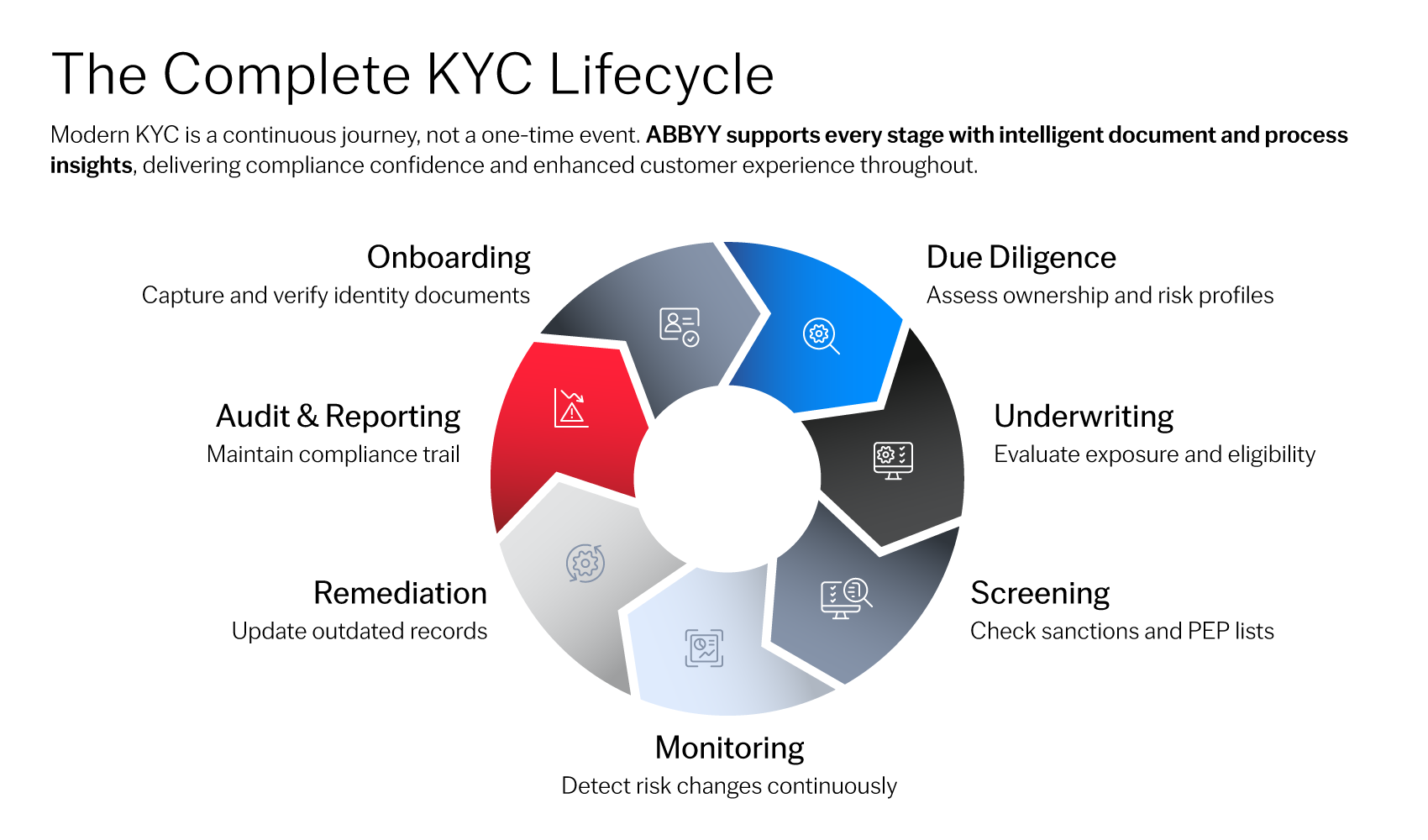
Staying on top of modern fraud requires a continuous approach to KYC—also known as perpetual KYC (pKYC)—that connects information across the entire lifecycle to identify anything out of the ordinary.
Connection is the critical factor. Modern fraud rarely reveals itself through a single document or isolated event. Risk emerges as information moves across systems and workflows over time. A document that appears legitimate at onboarding, for example, may later conflict with transaction patterns or newly submitted records.
This is why modern KYC requires visibility into how documents and activities connect across the workflow. It’s only with the bigger picture that organizations can spot inconsistencies and anomalies. Point solutions that tackle individual tasks, while useful, lack the end-to-end visibility organizations need to identify nascent risk patterns. A more holistic view requires:
- Document intelligence that quickly and accurately extracts, validates, and understands information from large volumes of structured and unstructured documents. Document AI for KYC speeds up customer onboarding by automating ID verification, document checks, and due diligence.
- Process intelligence that provides visibility into how documents and data move across workflows to identify anomalies or compliance gaps.
- Document forensics that evaluates the authenticity of submitted records by checking for inconsistencies and signs of tampering.
- Real-time monitoring that evaluates customer activity and emerging risks continuously and keeps customer records current for a continuous KYC cycle.
- Explainable AI whose analysis and decisions come with traceable audit trails and can be understood and defended by both internal teams and external investigators.
Only with these capabilities can organizations move beyond static verification models toward an adaptive approach to KYC that can spot suspicious activity earlier and respond with greater transparency and consistency.