For financial institutions, falling behind on compliance has become an incredibly expensive problem in recent years. In the first half of 2025 alone, regulators globally issued $1.23 billion in fines related to anti–money laundering (AML), Know Your Customer (KYC), sanctions, Suspicious Activity Reports (SARs), and transaction monitoring violations.
Digital fraud like synthetic IDs and phishing scams is rising sharply, and regulators are responding with tougher oversight and record fines. Yet, many financial institutions still rely on fragmented compliance processes built on manual reviews, legacy systems, and inconsistent data validation. These approaches don’t just slow down onboarding—they create gaps that regulators penalize and auditors flag.
The problem is compounded by the sophistication of modern fraud. With the tools fraudsters now have at hand, it’s nearly impossible for human reviewers to reliably spot forged or manipulated documents. Manual review is no longer just inefficient—it’s insufficient to protect institutions from financial crime and regulatory risk.
Advances in AI-driven technology now offer a way forward. Document AI helps financial institutions replace fragmented workflows with automated data capture, validation, and monitoring. Instead of reacting to gaps, compliance teams can maintain consistent, auditable processes that scale with regulatory demands. With rules tightening every year, understanding today’s compliance landscape is the first step toward seeing where Document AI and Process AI can make the greatest impact.
Jump to:
From defensive to proactive compliance in financial services
Document AI for KYC compliance: Faster, safer onboarding
Document AI for AML: Stronger monitoring with fewer gaps
How Process AI supports KYC and AML
How to evaluate Document AI solutions for AML and KYC compliance
Trends and innovations in AML and KYC compliance
Use cases: Document AI and Process AI in action
Why ABBYY sets the standard in Document AI for AML and KYC compliance
From defensive to proactive compliance in financial services
Compliance was once viewed primarily as a defensive function, a necessary cost to avoid penalties. Yet, today’s tougher regulations and rising fines mean banks are watched closely by regulators and investors alike. Leading institutions now treat good compliance as a strategic advantage that proactively signals reliability and resilience.
Document AI, in combination with advanced AI-based document forensics providers, is helping banks make this shift in two critical areas:
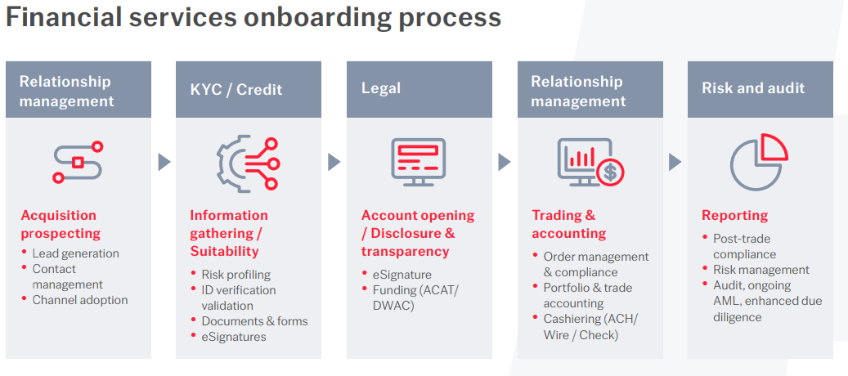
- In KYC processes, it speeds up customer onboarding by automating ID verification, document checks, and due diligence
- In AML programs, it strengthens fraud detection, customer due diligence (CDD), enhanced due diligence (EDD), and sanctions and politically exposed person (PEP) screening—helping institutions meet regulatory reporting requirements.

Process intelligence adds another layer of protection by revealing how customers and employees interact with processes and documents in real-time. This helps spot process loopholes and potential fraud risks so financial institutions can counter vulnerabilities before they lead to problems.