The rules around KYC are governed by several national and international laws. Most KYC laws fall under AML regimes. These regimes are based on the recommendations of the Financial Action Task Force (FATF), a pan-government organization formed to fight money laundering, terrorism, and proliferation financing.
In the United States, there are four key laws and regulatory bodies overseeing KYC compliance:
- The Bank Secrecy Act (BSA) of 1970: Under BSA, financial institutions are required to record cash purchases, report cash transactions over $10,000, and flag suspicious activity.
- The USA PATRIOT Act of 2001: This Act broadened BSA requirements. It incorporated CIP into KYC procedures, strengthening customer due diligence and verification to combat terrorism financing and money laundering.
- Financial Crimes Enforcement Network (FinCEN): FinCEN, and the Office of Foreign Assets Control (OFAC), sets standards and shares guidance for KYC compliance.
- Financial Industry Regulatory Authority (FINRA): Under the PATRIOT Act, broker-dealers must have an AML compliance program. FINRA provides AML program guidelines, including those that involve a risk-based approach to customer verification.
Some of the other key international KYC laws include:
- The European Union’s Anti-Money Laundering Directives (AMLD), which outlines comprehensive KYC and AML requirements for EU member states.
- The Money Laundering Act – 2017 (MLA) governs the UK, defining customer verification rules for reporting entities.
- Proceeds of Crime (Money Laundering) and Terrorist Financing Act (PCMLTFA) of Canada sets the KYC requirements and rules for reporting entities.
KYC compliance laws apply to global businesses across a range of industries, with some industries implementing more stringent rules in recent years. Some of the biggest industries required to comply with KYC are:
Banking
KYC was created for banks and financial institutions, so companies in the banking sector face the strictest compliance requirements. Bankers and advisors are required to identify
- their customers;
- beneficial owners of businesses; and
- the purpose and nature of customer relationships.
Banks also have to check customer accounts for suspicious or illegal activity and continuously ensure the accuracy of the accounts.
Much like the banking sector, there are strict KYC rules for financial services organizations. They’re required to verify the identity of their customers, understand the nature of their financial activities, and ascertain risk profiles through KYC checks. To comply with AML regulations and prevent financial crimes, they also need to continuously monitor customers' transactions, maintain detailed records, and report suspicious activities.
Cryptocurrency
Cryptocurrency companies are classified as money services businesses (MSBs), so they also have to comply with some AML laws. This involves:
- Implementing customer identification programs
- Maintaining specific reporting and record-keeping procedures
Since fiat-to-cryptocurrency exchanges facilitate transactions involving both national currencies and cryptocurrencies, they’re required to follow KYC measures to ensure compliance.
Insurance
To comply with KYC regulations, insurance companies must verify the identity of policyholders and beneficiaries, and conduct due diligence to prevent money laundering and terrorist financing. The USA PATRIOT Act also mandates insurers to establish AML programs, report suspicious activities, and maintain comprehensive records.
Real estate
Under KYC regulations, real estate professionals should perform customer due diligence to prevent money laundering. Real estate businesses in the US must also comply with AML regulations when conducting transactions through financial institutions. FinCEN is authorized to issue Geographic Targeting Orders (GTOs) in high-risk jurisdictions, mandating insurance companies to identify the individuals behind companies or entities used in high-value or cash real estate transactions.
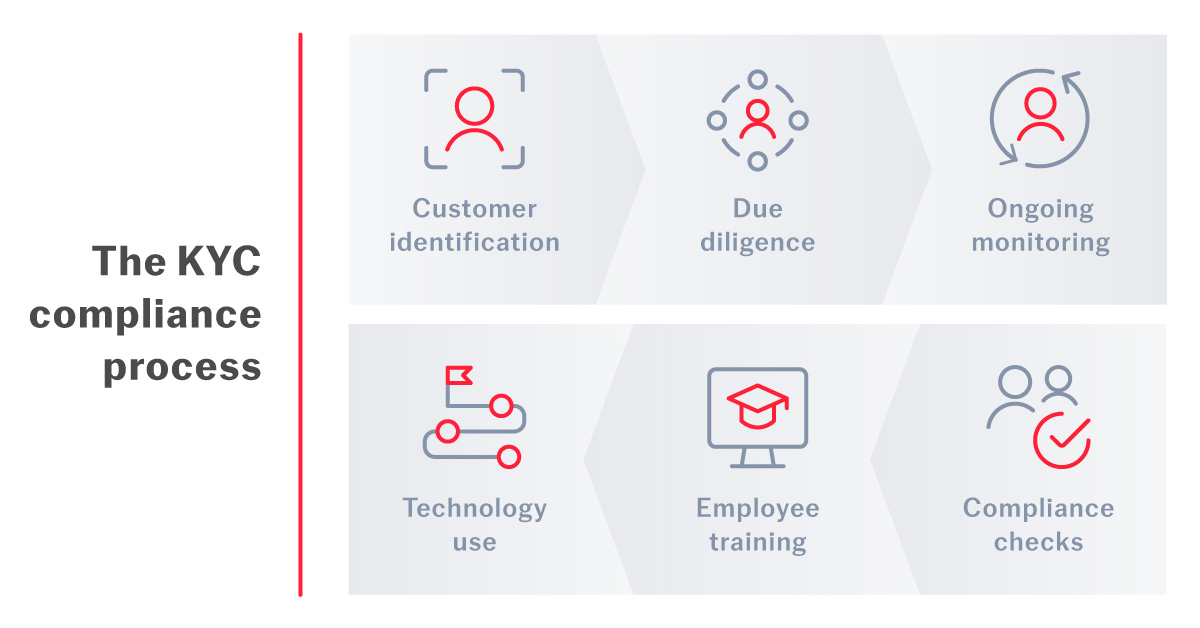
The KYC process begins with the Customer Identification Program (CIP), where financial institutions gather a customer’s basic identifying information:
- Name
- Date of birth
- Address
- Identification number
Institutions will typically gather this information when the customer opens an account, but they’re required to verify the account holder’s identity “within a reasonable time.” Customer identification is carried out by verifying documents like passports, driver's licenses, or social security numbers, and sometimes using non-documentary methods like database checks.
Customer Due Diligence (CDD) is the next stage, where institutions will ascertain more information about the customer's financial behavior and transaction patterns to develop a risk profile for them. If a customer is high risk, at this stage, the institution will perform Enhanced Due Diligence (EDD), involving in-depth background checks and monitoring. Organizations keep comprehensive records of all this KYC information.
A critical, lesser discussed component of the KYC process is ongoing monitoring, where customer transactions are continuously observed to spot unusual activities. Any suspicious transactions or behavior is then reported to the relevant authorities. Institutions will also carry out periodic reviews to ensure customer information is up-to-date and accurate.
Institutions will train employees and use technology to streamline and improve their KYC procedures, ensuring compliance with regulations and minimizing the risk of financial crimes.
Develop a KYC policy
Developing a robust KYC policy is essential to ensure compliance with international regulations against fraud, money laundering, and terrorist financing. Having clear measures for implementing KYC also helps to foster more secure financial transactions.
Financial institutions usually base their KYC policies on four key elements:
- Customer policies
- Customer identification procedures, including identity checks, verification, data collection, Politically Exposed Persons (PEPs) and sanctions lists checks
- Risk assessments and management
- Ongoing monitoring and record-keeping
Conduct employee training
Employee training is critical for communicating, controlling, and safeguarding knowledge of Anti-Money Laundering / Countering the Financing of Terrorism (AML/CFT) and KYC requirements within an organization. At a minimum, training in these areas should cover:
- Ways that money laundering and terrorist financing may be carried out with the company’s products and services
- Internal policies to prevent fraud, money laundering, and terrorist financing, and to escalate suspicious activity
- General information on AML/CFT and KYC regulatory compliance requirements
- How to identify and report transactions to a regulator or authority
Implement a robust Customer Identification Program (CIP)
A successful Customer Identification Program (CIP) hinges on thorough risk assessments at both the institutional and individual account level. Global CIP guidelines offer useful directions which should lay the foundation for every CIP policy. However, it’s the responsibility and discretion of each institution to define its own risk levels and internal policies. Like other AML compliance measures, CIPs should be clearly and formally documented to guide all employees and satisfy regulatory requirements.
To create a CIP that’s robust and tailored to your institution's risk-based approach, you’ll need to consider factors such as:
- The types of account you offer
- Account opening methods
- Available identification information
- The size of your institution
- Your institution’s location and customer diversity across different geographic areas
Leverage advanced KYC technology
Financial services institutions face a unique set of challenges. Crimes, such as fraud, terrorist activity, and money laundering, are committed by bypassing banking processes or using suspicious documents, resulting in billions of dollars in fines and legal risks. Although evolving regulations aim to solve these problems, these institutions often find themselves with fractured processes and repetitive due diligence requests, causing further problems, including:
- Longer onboarding times
- Higher service costs
- Decreased customer satisfaction
- Increased risk of non-compliance with KYC
ABBYY Timeline, our advanced AI-powered process intelligence platform, is a comprehensive solution designed to target these vulnerable areas in KYC processes:
- Increased process transparency. Timeline helps financial institutions discover complex interactions between customers, employees, processes, and content. It gathers the necessary data on end-to-end processes to help you identify opportunities for improvement, and ensure ongoing compliance monitoring.
- Streamlined onboarding. KYC begins with initial contact, from customer account creation to document authentication. Integrating onboarding with customer interactions can detect suspicious activity. ABBYY intelligent document processing (IDP) automates document intake for KYC compliance.
- Full process visibility. ABBYY Timeline goes beyond just visualizing processes—it uncovers crucial human and content interactions. It shows where customers and employees engage, input, review, and decide on critical content, enabling you to identify content types and interaction patterns to flag suspicious activity.
- Rapid crime and fraud detection. Banks are most vulnerable to potential crimes and fraud due to process loopholes and suspicious documents. ABBYY process mining and IDP help banks identify and counter these vulnerabilities early, establishing document authenticity from the start.
Request a demo to find out how ABBYY Timeline could improve your KYC compliance process and streamline your business critical processes.
While KYC regulations are designed to be clear and robust, there are increasing challenges to implementing them.
A benefit of the international commitment to preventing financial crime is that legislation is regularly updated to mitigate industry risks. However, evolving regulations put pressure on organizations to continually update their policies and processes. Aside from the red tape involved in adapting internal governance processes, adhering to regulatory developments is often costly as it involves retraining staff, updating documentation, and, at times, upgrading systems.
In addition, with the increasing significance of data privacy, regulators are imposing stricter rules on businesses to safeguard customer data and use KYC information solely for its intended purpose. Balancing due diligence to protect customer data, while fielding the risks of financial crime, can be difficult to balance. Coupling these challenges with the growing digitization of the KYC process, it can be difficult for institutions to keep up with regulations.
Digital transformation across KYC compliance processes has led to the advent of eKYC, where businesses use online processes to verify customer identities and transactions. Financial services companies increasingly use mobile and web-enabled solutions that incorporate on-device technology and biometric authentication (such as facial recognition) to accurately identify customers in the digital environment.
The combination of cutting-edge technology, compliant machine learning, and identity expertise has established eKYC as a legally recognized form of identification, extensively employed for AML compliance. For instance, in India, the use of eKYC is facilitated by Aadhaar, the national biometric eID scheme. It covers 99.9% of the adult population, providing swift and reliable customer onboarding and verification.
At the forefront of digitizing KYC processes, ABBYY’s AI-driven solutions are built to support digital KYC compliance for financial services companies that want to implement seamless and secure online and mobile identity proofing.
Your customers will be able to onboard through their mobile or desktop, helping you to reduce abandonment rates and customer churn. Paired with our intelligent document processing solutions, you can automate your most data-heavy processes and implement continuous monitoring.