

Imagine a workplace where mundane tasks and clunky processes are automatically taken care of, so every team member can focus on creativity, innovation, and strategic thinking. Intelligent automation is turning this vision into reality today, empowering employees at every level to concentrate on meaningful work that drives business growth. In this article, we’ll explore what intelligent automation is, why it benefits businesses, and how it’s transforming industries.
Jump to:
What is intelligent automation (IA)?
Why is intelligent automation important?
How does IA (intelligent automation) work?
Benefits of intelligent automation
Intelligent automation examples and use cases
Technologies used by intelligent automation
Intelligent process automation vs. robotic process automation
Future of intelligent automation
How can ABBYY help with intelligent automation requirements?
What is intelligent automation
Intelligent automation (IA) combines AI-driven technologies with robotic process automation (RPA) to improve operational efficiency and decision-making. A key goal of IA is to speed up and enhance business processes, so that even complex workflows can be performed automatically with minimal human intervention. By combining cognitive capabilities with automation, businesses can lower costs while improving processes and increasing productivity to better adapt to dynamic environments.
Why is intelligent automation important?
Today’s business environment is defined by growing volumes of unstructured data, rising customer expectations, and bottom-line pressure. In this context, intelligent automation (IA) has become essential. It enables businesses to accomplish more in less time by using technology to automate and improve many processes—especially those involving large amounts of documents or data.
IA not only extracts and puts into use valuable insights from data but also fuels faster processes and more accurate results. At the same time, it frees up employees to focus on strategic and creative work that drives innovation and growth. It also increases visibility into business processes, enabling more informed decision-making and facilitating regulatory compliance.
In short, IA equips businesses to thrive in a fast-changing, data-driven world by combining efficiency with the agility needed to adapt and succeed.
How does IA work?
A simple way of thinking about intelligent automation (IA) is as a much smarter, upgraded version of traditional robotic process automation RPA) tools. While RPA is useful for rule-based tasks like data entry or simple workflows, intelligent automation adds more advanced intelligence through the use of AI and automation technologies, making it smart enough to automate more complex processes—and even improve the processes themselves. IA can:
- Transform unstructured data into action-ready formats for specific business needs
- Interpret documents, images, and other content with human-like accuracy
- Continuously improve processes and make data-driven decisions as insights evolve
- Reveal bottlenecks in processes, along with primary paths and customer journeys
- Identify inefficiencies and pinpoint areas where automation can have the most impact and return on investment
- Integrate people, processes, and automation tools to create a unified workflow
With IA, businesses can go beyond automating simple tasks to optimizing entire workflows from start to finish. The result? Faster operations, fewer errors, and more time to focus on what really matters.
Benefits of intelligent automation
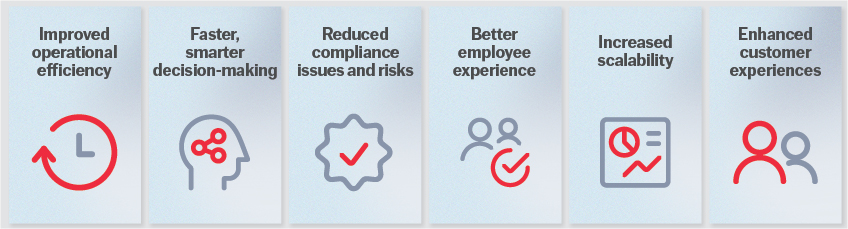
Intelligent automation (IA) can make profound and fundamental changes in how organizations get work done. Here are some of the key ways IA creates value:
Improved operational efficiency: By automating processes and reducing human errors, businesses can make better use of resources and speed up processes.
Faster, smarter decision-making: IA can transform document-bound data—whether in structured, semi-structured, or unstructured formats—into actionable insights and offer real-time analytics to help teams make quicker and more informed decisions.
Reduced compliance issues and risks: With full visibility into business processes, companies can maintain regulatory compliance and minimize errors that could lead to costly risks.
Better employee experience: Employees can shift their focus to more innovative and high-value work that makes a bigger impact on long-term business success.
Increased scalability: IA provides flexible, adaptable tools so businesses can easily implement and expand automation across teams, processes, and locations.
Enhanced customer experiences: By optimizing and speeding up processes, IA enables faster response times that create smoother and more satisfying customer journeys.
Intelligent automation examples and use cases
Industry-specific
Healthcare
The healthcare industry is in the midst of a digital revolution, thanks to intelligent automation (IA) and its wide-reaching effects on all aspects of healthcare administration and patient care. Use cases include:
- Optimizing revenue cycle management to shorten the gap between billing and payment
- Taking manual data entry out of patient registration procedures
- Automating the processing of patient referrals to reduce revenue leakage
- Reducing the cost of processing claims forms
- Streamlining patient data management for seamless information access
- Enhancing regulatory compliance in healthcare documentation
Financial services and banking
Many tasks essential to delivering great financial services can also be repetitive and tedious for employees to perform day in and day out. That’s where IA can help. Use cases include:
- Optimizing loan application processing to reduce approval times
- Eliminating repetitive manual processes involved in processing documents to conserve internal resources
- Improving process visibility for chargeback representment to defend valid transactions and recover revenue
- Automating document intake processes to ensure compliance with KYC and AML
- Streamlining internal compliance processes around insider trading
- Delivering a seamless customer experience for mobile customer onboarding
Insurance
The right IA tools can empower the insurance industry to improve customer experiences and build trust. Use cases include:
- Expediting the intake and initial review process for claims first notice of loss (FNOL)
- Increasing accuracy and speed in time-to-close
- Reducing errors and fraud in claims-related invoice processing
- Accelerating claims assessment to reduce processing times
- Giving customer service agents immediate access to customer and policy information
- Streamlining underwriting by quickly evaluating risks to issue policies more efficiently
- Implementing AI-powered document-centric identity proofing to prevent fraud
Transportation and logistics
To keep things running quickly and efficiently in transportation and logistics, shipments need to arrive on time, every time. IA helps make that possible. Use cases include:
- Streamlining the documentation process for international shipments
- Processing dangerous good declarations accurately, every time
- Expediting documentation handling from filing to release of goods at customs clearance
- Simplifying payment of customs duties, taxes, and fees
- Eliminating error-prone and time-consuming manual data entry in shipment tracking and tracing
- Accurately tracking incoming and outgoing goods in warehouse and inventory management
- Digitally transforming order and delivery processing to expedite the entire process
Shared services
Finance and accounting
IA helps finance and accounting departments improve accuracy and efficiency. Use cases include:
- Speeding invoice processing by extracting and validating data from documents
- Streamlining expense management by categorizing transactions automatically
- Simplifying financial reporting by consolidating data in real-time
- Enhancing data accuracy and reconciliation by cross-checking records
- Optimizing document approval processes
Remote onboarding and digital onboarding
IA can speed up the customer onboarding process, saving new customers time and effort as they get started. Use cases include:
- Simplifying identity proofing and affirmation with facial matching and document verification
- Boosting onboarding completion rates by enabling customers to upload documents directly from their mobile devices
- Speeding up account setup by integrating multiple workflows
- Enhancing task tracking by automating notifications for onboarding milestones
Technologies used by intelligent automation
- Robotic process automation (RPA): One of IA’s foundational technologies, RPA automates repetitive, rule-based tasks like data entry. While RPA efficiently addresses rote, structured tasks, it needs to be complemented by other technologies like AI to automate more complex tasks and processes.
-
Process mining: Another crucial IA technology, process mining is a data-driven approach used to understand and improve business processes. It works by analyzing data from information systems to track how processes are carried out. This data, often collected in the form of logs, can be "mined" to create an audit trail that shows all the steps involved in a process.
Process mining follows these trails to build a detailed model of the process, including any variations or inefficiencies. With this clear view of how processes are functioning, organizations can apply automation more effectively, targeting the areas that will deliver the most value.
- Intelligent document processing (IDP): By bringing human-like decision-making capabilities to business processes, AI plays a critical role in the automated processing of business documents, i.e., intelligent document processing. IDP technology captures and extracts data from various document formats, ensuring that the right information is used in business workflows. AI also supports predictive analytics, offering businesses the ability to make data-driven decisions in real-time to improve efficiency and performance.
- Machine learning (ML): A subset of AI, machine learning allows systems to learn from data and improve over time, so they can automate more complex processes without explicit programming. In intelligent automation, ML is used to continuously improve processes like document recognition and data extraction.
- Natural language processing (NLP): As a key AI capability that allows systems to understand and interact with human language, NLP is essential in intelligent automation when processing unstructured text, such as emails, contracts, or customer feedback. NLP helps systems to understand the context, sentiment, and meaning behind the text.
- Generative AI (GenAI): An advanced form of AI, GenAI can make new content, such as text, images, or even solutions to problems based on the data it was trained on. GenAI augments automation with reasoning capabilities, helping to offload more manual tasks from knowledge workers. GenAI models are very adaptable, so organizations can customize them for specific business needs to improve efficiency and drive innovation.
Intelligent process automation vs. robotic process automation
Intelligent process automation (IPA) and robotic process automation (RPA) are both automation technologies, but they differ significantly in their capabilities. Here's a breakdown of the differences between IPA and RPA:
| Robotic process automation (RPA) | Intelligent process automation (IPA) | |
|---|---|---|
| Scope | Automates repetitive, rule-based tasks within structured systems. | Automates and optimizes entire business processes, handling both structured and unstructured data. |
| Technology | Relies on rule-based bots and lacks adaptability to unstructured data. | Combines RPA with AI technologies like intelligent document processing (IDP) and process mining for intelligent decision-making. |
| Complexity | Best for simple, repetitive tasks such as data entry. | Automates complex, dynamic processes that require decision-making and context analysis. Optimizes complex processes. |
| Dependencies | Automates simple tasks within existing systems and connects to different business systems. | Integrates RPA with AI, predictive analytics, and process mining for end-to-end process optimization and deeper insights. |
| Scalability | Can scale to handle high volumes of repetitive tasks. | Can scale to handle complex and dynamic processes. |
| Benefits | Increases efficiency by automating specific, routine tasks. | Provides greater operational efficiency, smarter decision-making, and the ability to optimize entire workflows and processes. |
Learn more: How Intelligent Process Mining Improves RPA Results
Future of intelligent automation
As more businesses tap into the power of intelligent automation in the coming years, we can expect to see artificial intelligence (AI) being integrated deeper within automation tools to make more complex decisions. Automation will increasingly track, adjust, and improve processes as they happen—requiring less and less human intervention. Organizations will be able to adapt more quickly to changing business environments as real-time data automatically gets analyzed to seamlessly trigger a continuous fine-tuning of processes.
IA will also get increasingly easier to implement. With low-code and no-code platforms already available today, business users without technical expertise can set up and manage automation skills by themselves. We’ll see more businesses choose these user-friendly options to skip the need for coding.
On the horizon, agentic automation is now elevating the art of the possible in automation to a whole new level, where AI agents are empowered to make decisions and act autonomously. And as all these advances and trends become the norm, intelligent automation will scale even more rapidly across teams, processes, and industries.
How can ABBYY help with intelligent automation requirements?
At ABBYY, we empower businesses to optimize their processes and make smarter decisions through intelligent automation. Our purpose-built models for intelligent document processing (IDP) use AI to automatically extract data from any document type with exceptional accuracy. ABBYY Document AI introduced the industry’s first low-code/no-code IDP platform, with a user-friendly interface that lets business users without coding knowledge or technical training to create and use custom document skills.
In addition, our cloud-based Process AI platform offers deep insights into business inefficiencies so you can uncover the most important automation opportunities, refine your processes, and improve operational efficiency across your organization. ABBYY Timeline process intelligence also empowers you to simulate process improvements so you can better predict outcomes before implementation.
To unleash the full potential of your business operations with intelligent automation solutions, get in touch with one of our experts today.