Pushing the Boundaries of IDP: Object Detection, Word Recognition, and Key-Value Extraction
by Max Vermeir, Senior Director of AI Strategy
One of the most defining characteristics of intelligent document processing (IDP) is the strategic use of artificial intelligence (AI) as the core foundation for automating document-centric tasks. AI models and algorithms enable contextual understanding to improve speed and accuracy, driving business value for customers with document-heavy workflows.
ABBYY Vantage exemplifies this concept with its library of pre-trained “skills,” also known as pre-trained AI document processing models. By narrowing the scope of an AI solution to excel at a specific task, these purpose-built AI skills work efficiently to accelerate outcomes in specialized contexts.
In a recent showcase session presented by the ABBYY research and development team, our developers Konstantin Anisimovich, Evgenii Orlov, Ivan Zagaynov, and Andrew Upshinskiy explained three exciting new AI models that are pushing the boundaries of IDP in key-value extraction, object detection, and word recognition.
1. Key-value extraction
Identifying key information is an essential Vantage skill that allows for actionable data to be extracted from a document type. Document-specific models at the core of the skill are trained to identify fields such as “company name,” “address,” or “zip code,” enabling the corresponding values to be extracted. Separate models are made for different document types, determining the fields that the model will look for.
This process is known as key-value pairs extraction. This entails finding all possible “keys,” or field names; all possible “values,” which are the contents of those fields; as well as the associations between keys and corresponding values. But how is the model trained to make these associations?
Taking a large, general key-value extraction model and training it on a set of documents allows the model to build proficiency in automatic markup. Through a process called knowledge distillation, or the transferring of knowledge from a large AI model to a smaller one, more specialized AI models can be built that operate at a lower computational cost and greater inference speeds, than their larger counterparts.
ABBYY’s current path towards this solution consists of two independent workflows: entity extraction and linking models for general documents, and key summarization and QA models for text-heavy documents such as contracts. Both models are based on the transformer architecture that is ubiquitous in modern neural networks, e.g., the GPT-family and other LLMs.
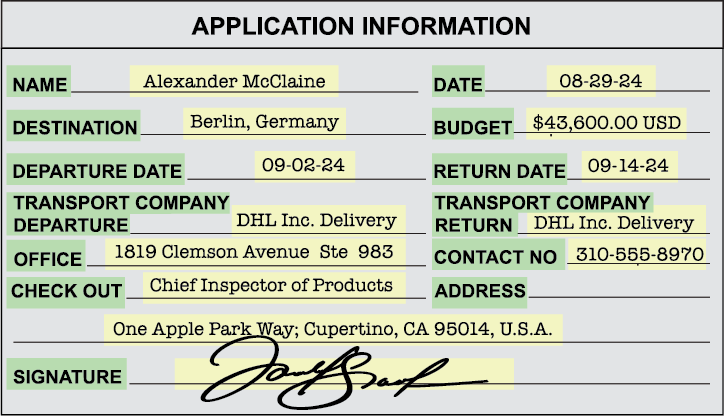
The image above portrays a form-like document where green highlights indicate keys, and yellow highlights indicate values that must be extracted from their respective keys. In a form, there are visual indicators such as layouts and blank cells that suggest where key-values lie. The world classification model tags each word as either a background or a part of a key or value, while the entity linking model combines the tagged words into key/value sequences and matches them together. Within this workflow, text is processed by a RoBERTa transformer, while visual data (images) are processed by a compact YOLOv8 model.
For text-heavy documents, a text summarization model extracts a list of all keys from the document, and a question-answering model finds corresponding value excerpts using information about the key. Once again, two separate models are used in this workflow: for key extraction, an encoder-decoder architecture uses a multimodal LayoutLM-like transformer encoder to extract rich features from the data, and a BART transformer decoder extracts relevant key word sequences using the encoded data. The value extraction model is based on a RoBERTa transformer and employs query paraphrasing and adversarial data to enhance performance.
Loading component...
Subscribe for updates
Get updated on the latest insights and perspectives for business & technology leaders
