

As businesses face increasing pressure to optimize operations and reduce costs, interest in process mining and process discovery has grown. Both are recognized for helping organizations understand and improve workflows by identifying inefficiencies. However, because these terms are often used interchangeably, their true meanings can get fuzzy.
Trying to choose between process mining and process discovery is the wrong approach because the two are actually two sides of the same coin.
In this post, we’ll clarify what process mining and process discovery are, explain why they shouldn’t be seen as separate tools, and reveal the comprehensive solution organizations need to truly optimize their processes.
Jump to:
Why process mining vs. process discovery is the wrong question
What are the benefits of process mining and process discovery?
What is process mining?
Process mining is a data-driven technique for analyzing event logs—records of events or activities generated by systems during business processes. By analyzing these logs—which typically include timestamps, activities, and case IDs, that track the steps of a process—process mining creates detailed visualizations that show how your systems are actually working.
Process mining sets the stage for process discovery, which we will explore next.
What is process discovery?
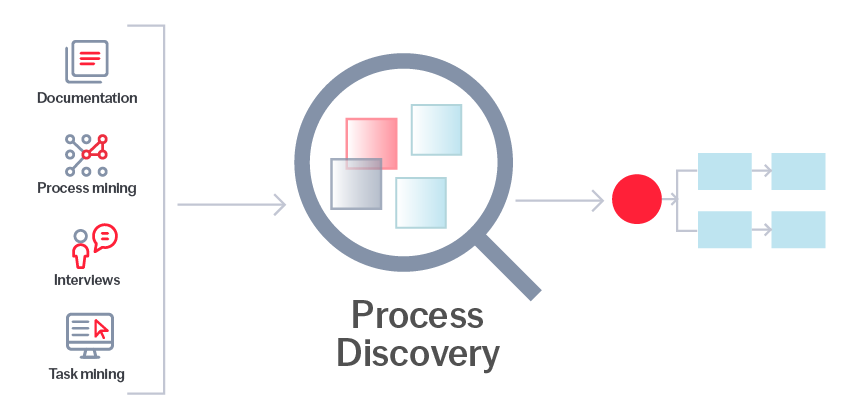
Process discovery, in simple terms, is one of the initial and key outcomes of process mining. And when task mining is incorporated, a holistic and comprehensive view of workflows is achieved. Process mining reconstructs processes, and task mining adds the ability to fill in the gaps by capturing user activities on their desktops.
For instance, in financial services, process mining can be used to analyze transaction logs and reconstruct the loan approval process from application submission to final approval. Task mining then observes the actions of loan officers as they navigate their desktop systems, capturing activities like manual data entry or document review that may not be reflected in the transaction logs. This combined approach uncovers areas for improvement in processes that businesses can optimize.
Together, process mining and task mining allow organizations to combine the strengths of both—data-driven process insights and the human perspective—for a richer, more holistic understanding of their workflows. This integration is what makes up more robust process discovery than what process or task mining can deliver on their own. It’s the key to ultimately uncovering not just the "what" of process performance, but also the "why.”
Why process mining vs. process discovery is the wrong question
If you’re wondering whether you should choose process mining over process discovery—or vice versa—you’re asking the wrong question. Because process mining is a crucial part of process discovery, focusing on them as separate concepts misses the bigger picture. Let’s explore some of the reasons why.
Bridging system and human perspectives
Process mining analyzes system-generated data to map processes, which is critical for understanding how workflows behave at a structured, system level. To that, process discovery needs to add task mining for the human user interface layer—including unpredictable, manual steps—giving you a complete picture that combines both your automated and human-driven processes.
Gaining a holistic view of business processes
Process mining is extremely powerful for mapping repetitive, system-driven tasks. Combining process mining with task mining for process discovery lets you also see complex or variable workflows that may involve ad hoc or non-standard steps. Businesses can get insights into even the most complicated or unusual operations clearly for a fuller understanding of how work gets done.
Identifying and designing automation opportunities
One of the most powerful advantages of robust process discovery is its ability to highlight automatable steps in your workflow. By integrating both process mining and task mining, process discovery offers insights into the human-driven aspects of workflows, enabling businesses to design automation that addresses both system and manual tasks.
What are the benefits of process mining and process discovery?
Process discovery that incorporates process mining and task mining is crucial for identifying bottlenecks, redundancies, and deviations in business processes. Here are the key benefits of process discovery and its components:
Understand business processes
By analyzing event logs, process mining reveals where your operations get stuck, slow down, or go sideways. Process discovery then combines this data with task-mining insights that show how human involvement influences your workflows. Together, they provide an X-ray-like view of how your business processes truly operate—covering both system-driven and human-driven aspects. This comprehensive understanding helps you pinpoint trouble spots and identify valuable opportunities for robotic process automation (RPA) or other automation technologies.
Improve compliance and risk management
Process mining continuously monitors business workflows to ensure compliance with internal guidelines and industry regulations. By revealing deviations from compliance standards, it lets organizations manage risks proactively and prevent issues before they escalate into major problems.
Optimize processes using data
With process mining and task mining, you can pinpoint high-impact areas where improvements would make the biggest difference. This is the essence of process discovery—helping your organization prioritize resources and optimize operations. Ultimately, process discovery helps ensure that your decisions are aligned with your overarching business goals.
Use cases for process discovery
- Healthcare workflow optimization: Process mining identifies communication delays between departments, while task mining captures human actions to provide deeper insights into how these delays occur. Together, these tools enable process discovery that helps hospitals fuel faster processes to improve patient care.
- Manufacturing process analysis: Process mining analyzes data from production, inventory, and shipping so manufacturers can spot delays in handoffs, duplicative work, or mechanical issues. When combined with task mining, process discovery uncovers the human factors that may contribute to these issues, helping manufacturers optimize their workflows, cut costs, and improve production speed.
- Insurance claims processing: Process discovery can transform the insurance claims process by integrating process mining to analyze the entire workflow—from claim submission to settlement. Process mining helps reveal delays in document handling or approvals, while task mining captures manual processes that might be causing those delays. By optimizing both system-driven and human-driven tasks, insurance companies can reduce turnaround times and enhance customer satisfaction with more efficient claims processing.
- Finance compliance: In the finance industry, process discovery combines process mining with task mining to uncover compliance gaps such as inconsistent reporting or missed approval steps. Process mining identifies issues within system-driven workflows, while task mining highlights human actions that might be overlooked. Together, these tools help financial institutions improve their reporting accuracy, ensure timely compliance, and enhance audit readiness.
- HR recruitment and onboarding: Process discovery can optimize HR workflows by combining process mining to analyze data on candidate screening and onboarding, with task mining to identify manual delays or redundant processes. For example, process mining might reveal delays in the screening process, while task mining captures slowdowns in paperwork or communication. By streamlining both automated and human aspects of recruitment and onboarding, organizations can hire talent faster and improve the overall employee experience.
- Customer service improvement: Process discovery offers a clear view of the customer journey, combining process mining to analyze system-generated data and task mining to capture human interactions. By uncovering delays or pain points—such as slow response times or miscommunication between teams—process discovery enables companies to optimize their workflows and provide faster, more responsive service, ultimately enhancing customer satisfaction and loyalty.
Process mining is an essential part of process discovery
When it comes to process mining and process discovery, the real issue isn’t choosing one over the other—it’s recognizing that process mining is an integral part of the process discovery approach. Businesses don’t need to choose between them; they need a comprehensive solution that includes both.
ABBYY Timeline offers this solution. A process intelligence platform with both process mining and task mining capabilities that helps organizations understand how their processes work, Timeline delivers end-to-end visibility into your operations, optimizing workflows across your organization. With ABBYY Timeline, you gain actionable insights that enable your teams to make smarter, data-driven decisions, improve performance, and drive meaningful process improvements.
To learn how ABBYY Timeline can help you unlock the full potential of your business processes and pave the way for more efficient, effective operations, get in touch with one of our experts.