
Back to ABBYY Blog
Seven Tips for Bringing Artificial Intelligence into Your Organization
June 29, 2020

Artificial intelligence (AI) is certainly the most revolutionizing technology of the digital age, as enterprises explore ways to utilize machine learning (ML) and other AI tools to harness customer insights, spot talent, and secure corporate networks. And while IT departments can rapidly deploy and leverage most technologies, the evidence suggests that CIOs need to pay extreme attention when implementing AI, particularly when utilizing technologies with strong ethical considerations.
AI suffers from a major problem of bias within companies — and this compromises the widespread adoption of AI in the enterprise. For instance, researchers at MIT and the University of Toronto found that the company’s facial recognition software confused women, especially dark-skinned women, with men.
The number of companies adopting AI has increased from 10% four years ago to 37% in 2019, according to Gartner’s survey of 3,000 CIOs. In the short term, companies should try to build an ethic around their use of AI. But they must also be strategic in integrating AI into business.
Fixing cultural bias

The concept of “test and fail” will be essential for the successful introduction of AI in the enterprise. AI needs a culture where failure is accepted, which is averse to the traditional IT-driven culture. By adopting a trial-and-error approach, AI algorithms can be refined and improved on an ongoing basis, ultimately resulting in the best return on investment.
The risk factor associated with the adoption of AI is also a barrier to enterprise adoption. The private and public sectors often think only three or four months ahead and prefer to do nothing rather than play with their jobs — the average length of employment of a CIO is now assessed in months rather than years. Changing this behavioral attitude will be necessary if companies are to be at the forefront of the adoption of innovative technologies and stay ahead of their competitors.
Firms that have already financed digital transformations, and have hardly benefited from them, are less inclined to bet on the “latest fad” of AI. However, AI holds great promise for bringing real transformations to the enterprise. Organizations that adopt the “test and fail” principle will learn quickly, grasp the coming wave of disruption, and take advantage of AI in their future operations.
Learn about ABBYY's approach to trustworthy AI here.
Include responsibility and accountability

To successfully implement AI projects in hypersensitive domains such as finance, where compliance with certain types of regulations is mandatory, you will need to incorporate accountability for specific factors related to mandatory regulations. This helps answer these types of questions:
- Who is responsible for the AI system?
- Can your organization guarantee that decisions made by AI are accurate?
- Are compliance controls in place?
By enabling accountability for these types of issues, it will create transparency and an accountable AI system.
Create an internal AI department

Setting up an in-house AI team will be one of the means that will allow you to develop your AI projects. By calling on AI talents in specific divisions, you will have a solid team that can help you recruit and retain your employees. New AI-related teams and job descriptions will need to be created by adding scientists, data engineers, and machine learning engineers to your staff.
Practicing participatory design
Another way to create a more sustainable solution to building responsible AI is to base it on participatory design, which includes the humans who are involved in the actual use of the final solution.
Picture this. If an automated software is to be used in a call center to help reduce an employee’s workload, it is preferable that customers, a call center supervisor, and a call center employee be involved in the development process.
Plan your AI budget
AI innovations are worth mining, but they are not tolerant of a zero budget. Currently, AI is having a significant impact on economic development and the redefinition of professional roles.
Deloitte conducted a survey of early adopters to clarify how they began their journey through AI, the AI budget they are willing to spend, and the return on investment they expect. Fifty-one percent of those surveyed said they would be willing to increase their investment in AI by 10% in the coming year.
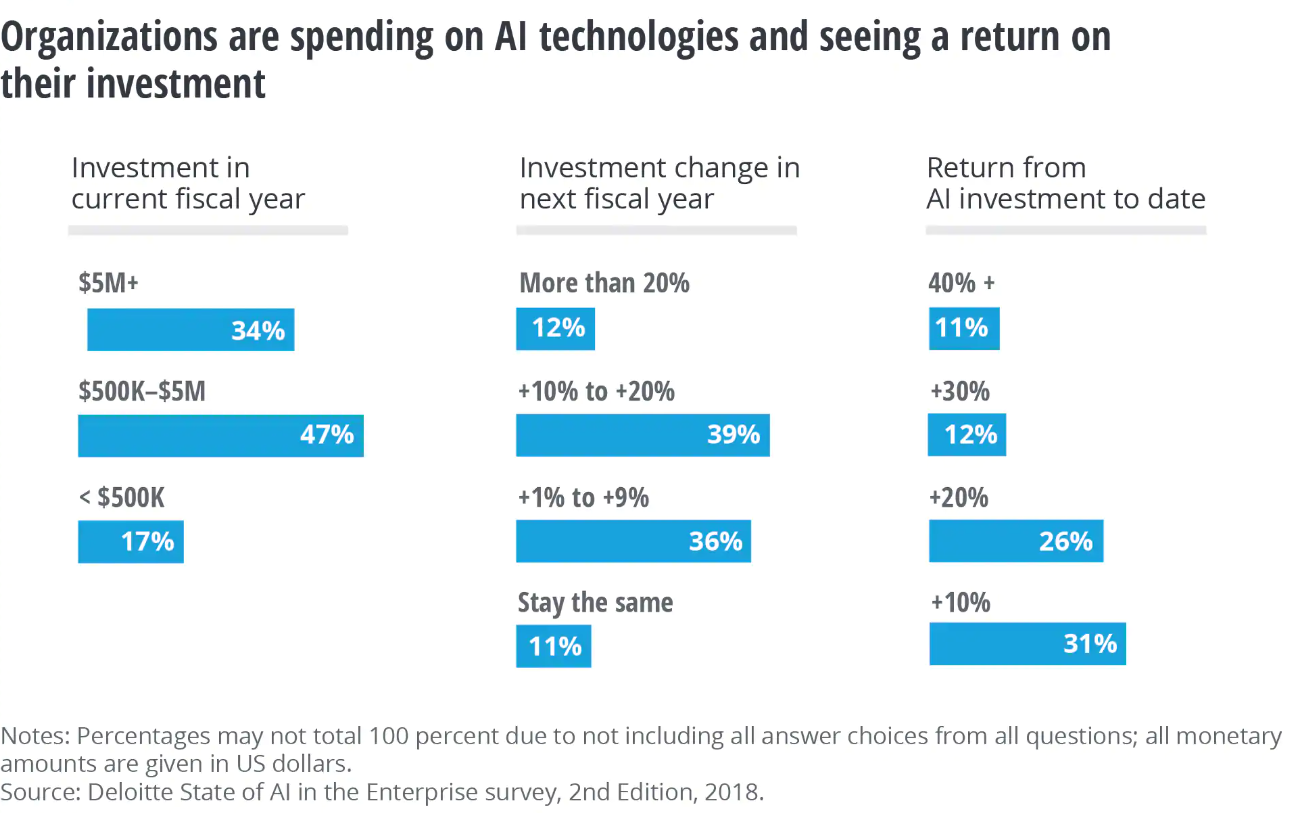
Source: Deloitte
Therefore, a key action to take quickly is to define a budget for your future AI project as it will require a lot of funds — the absence of which will result in the total failure of the project.
Start small and experiment

Although you want to develop your artificial intelligence strategy as quickly as possible, it requires a little patience and experimentation. It is best to create a small number of artificial intelligence resources that are difficult to implement. Tailor these resources so that they give you an advantage in your industry. This may require the use of specific data that has been carefully researched and used in the development of AI applications.
Alleviate employee’s displacement anxiety
The extent to which AI will eliminate or transform jobs is unclear, but companies should begin to educate their employees about how their jobs may change and recommend ways to re-qualify to remain relevant. This includes retraining workers whose tasks are supposed to be automated — or giving them time to look for a new job. A concrete illustration of this is Insurer State Auto, which is training its staff to handle more complex claims, as robotic process automation (RPA) frequently handles lower-level tasks.
Conclusion
The question now facing companies is how to create an investment program for AI that sustains, and how to change the organizational culture to address AI. Paradoxically, true innovation in AI will come from preparing companies to adopt the technology, not from training and implementing AI, which is increasingly becoming a commodity.
The promise of AI is exciting. When implemented in specific processes in your business, it should help create growth and will likely help make your business leaner and more agile. By using either of these tips, it will help you evolve your Artificial Intelligence strategy.
Continue the discussion:
In his recent interview with Unite.AI, Andrew Pery, Ethics Evangelist and Digital Intelligence Consultant at ABBYY, discussed ethics in AI, abuses of AI, and what the AI industry can do about these concerns moving forward.
Subscribe for blog updates
Loading...
- Why Global Enterprises Trust ABBYY
- Essential Skills Needed to Make Procure-to-Pay a Reality
- Automate Customer Onboarding: Faster, Safer, and Compliant with Document AI
Tag a friend