Benefits of OCR
OCR is an essential technology for every industry working heavily with documents, be it the day-to-day work that employees have with their current documents, digitizing archives, or creating accessible digital document repositories by processing a large volume of documents, for example, batches of healthcare documents or logistics documentations.
Businesses can benefit from OCR tools in a variety of ways.
- Increased productivity and performance. Alleviate manual work of data entry and retyping. A typical document containing about 300 to 500 words takes approximately 10 minutes for a person to manually copy—on the other hand, OCR can do this task in about 10 seconds, reducing time spent on physical paperwork by 75 percent.
- Accuracy rates as high as 99.8 percent. That is much more accurate than humans who tend to make more mistakes.
- Increased security and improved compliance. Physical documents are more likely to be lost, stolen or damaged and digitizing documents provides more secure storage. Additionally, image-based digital documents (scans, image-only PDFs) are not searchable without OCR, therefore those formats do not comply with accessibility requirements.
- Cost savings. OCR solutions provide accurate data capture and effective digitization, lower the risk of costly human errors that can derail processes and lead to financial penalties.
Common use cases for OCR solutions can include organizations to facilitate compliance with government and corporate regulations by converting large volumes of paper and digital documents into accessible and searchable formats, legal firms converting paper contracts into editable digital formats for search, eDiscovery, and data analysis, healthcare companies transferring patient records onto their computer system maintaining HIPAA compliance, libraries and archives preserving historical documents in digital form enabling employees across an organization to perform their various daily document-related tasks effectively, software developers to create content services, digital archiving, document management system (DMS), enterprise content management (ECM) solutions, and many others.
What is IDP?
Intelligent document processing (IDP) enables straight-through processing of documents by automatically capturing, extracting, and processing data embedded in business documents, in just about any process in any industry.

How it works
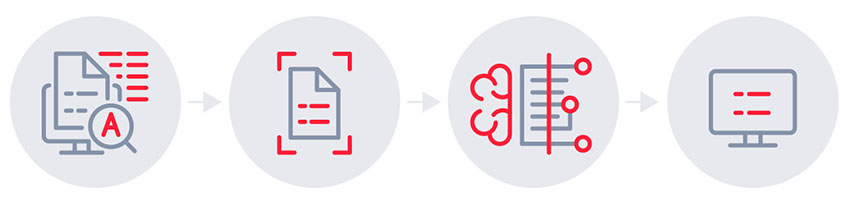
IDP incorporates optical character recognition (OCR) to convert printed or handwritten text into typed text/machine-readable format. IDP also applies artificial intelligence (AI) and machine learning (ML) techniques to read, understand and process structured, semi-structured, and unstructured data in documents like a human.
IDP uses machine learning models to classify documents into different categories based on their content, layout, or other characteristics. For example, invoices might be categorized as "Invoices," contracts as "Contracts," and so on. The categorized documents are then passed on to pre-trained extraction models, which analyze and understand the data within the document in a human-like manner and are capable of extracting business-critical information. The data can be validated against specified rules or, for example, a company database of clients, and if it encounters problems, it can flag it for human assessment. This so-called human-in-the-loop (HITL) feedback enhances the extraction models, which are constantly learning and improving based on manual corrections.
By incorporating natural language processing (NLP) the technology is also able to interpret the context of the information it is reading. For example, is the word “jaguar” referring to a large cat or a car? Or is the word ‘Sue’ referring to a person or a legal action? By applying NLP, an unprecedented recognition of unstructured data is identified and extracted, and can operate like a human brain, quickly adapting to changing input, and generating the best possible result. This sort of advanced level of technology is known as intelligent automation or hyper automation.
The IDP platform can be easily integrated into a variety of different business systems, such as ERP, or CRM. With new low-code/ no-code platforms, citizen developers can deploy IDP technology in a matter of days without need for massive IT infrastructure support and maintenance on client’s side.
Benefits of IDP
Across all industries, businesses are facing pressure to do more—and do it faster—with fewer skilled resources. Organizations are focusing on improving experiences for customers and employees as a key to improving revenue, margins, and retention. Intelligent document processing (IDP) can deliver significant benefits on both counts, enabling companies to achieve successful digital transformation.
IDP technology closely mirrors the way humans understand and manage documents, saving time and money, while also reducing the risk of costly errors.
Significant benefits of IDP include:
- Times saving and enhanced efficiency. Particularly for industries that handle high volumes of paperwork such as financial services, healthcare, logistics and legal. With IDP invoice processing times can be reduced by as much as 90 percent, equating to a 400 percent increase in employee productivity. That was the case with Metro AG which uses ABBYY’s intelligent document processing to reduce the turnaround time for invoices from an average of one to two days to just one hour.
- Improved accuracy. Machines don’t get distracted or tired and make costly mistakes like humans. Fewer errors and faster operations are realized with IDP.
- Better customer service. Faster processing times, more accurate data handling, and quicker response to client queries contribute to an overall improved customer experience, which can lead to higher customer satisfaction and loyalty.
- Faster decision making. By rapidly processing and extracting insights from documents, IDP enables faster decision-making. This is particularly beneficial for industries where timely decisions can have a significant impact, such as finance and customer service.
- Better security and compliance. IDP can help enforce compliance by ensuring that documents are processed according to established rules and regulations.
- Scalability. As business operations grow, the volume of documents to be processed also increases. IDP solutions can easily scale to handle larger document volumes without a proportional increase in labor costs.
- Easy integration to company workflow. IDP can be integrated with other digital systems and workflows to enable seamless and efficient digitization of business processes across company departments and your entire organization.
What’s the difference between OCR and IDP?
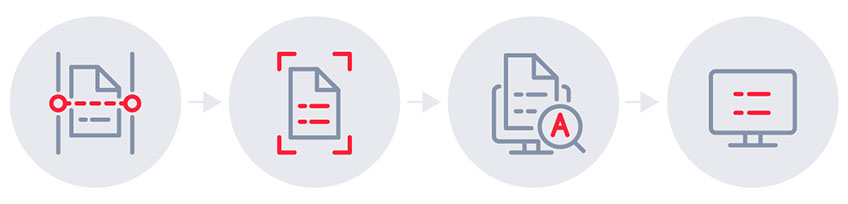
OCR has been around for a long time and is known as a document capture-related technology. OCR is primarily used to extract text from paper documents, scanned images or photographs and convert them into typed text that can be edited digitally on a computer.
The technology is commonly used to digitize printed documents to make them accessible electronically, for example a scanned letter that may be uploaded, to change the name and address of the recipient. However, OCR does not understand the meaning of the text, it just focuses on recognition of the characters.
IDP, on the other hand, incorporates a broader range of capabilities and technologies which make it smarter. IDP not only uses OCR for character recognition, it also incorporates artificial intelligence (AI) and machine learning to read and understand what the text means and thus be able to use it to make decisions on its value and know what to do with it.
For example, it may read an invoice, take its content to be compared to a corresponding purchase order, compare the sums for accuracy, and then forward it to the head of finance for payment. IDP can handle complex document types and process structured, semi structured or unstructured data just like a human. It also learns from its mistakes through the use of machine learning.
| OCR | IDP | |
| What it does | “Reads” scans and images of documents and converts them into machine-readable, searchable documents and/or text. | Extracts meaningful data from structured (forms), semi-structured and unstructured documents to power intelligent automation. |
| How it works | Applies AI algorithms to transform analog paper documents into digital text incl. document structure and segmentation (text, images, tables, barcodes, checkmarks, signatures, lines, characters, fonts, font sizes, language, etc.). | Uses the full-text provided by OCR as basis input and applies AI, NLP, ML regular expressions, and rules to understand the information in the document and extract tagged, meaningful data which can be passed onto down-stream business applications for informed decision-making. |
| Technology | Image enhancement Object detection OCR / ICR |
|
| Typical use cases | Provides access to machine-readable text as basis for: PDF conversion Digital archiving / Search eDiscovery Advanced search / Digital forensics Data analysis Intelligent document processing (IDP) | Automation of any document-centric business process: Accounts payable automation Customer onboarding / KYC Loan processing Automation of transportation & logistics documentation Insurance claims processing |