Common points of friction in customer onboarding
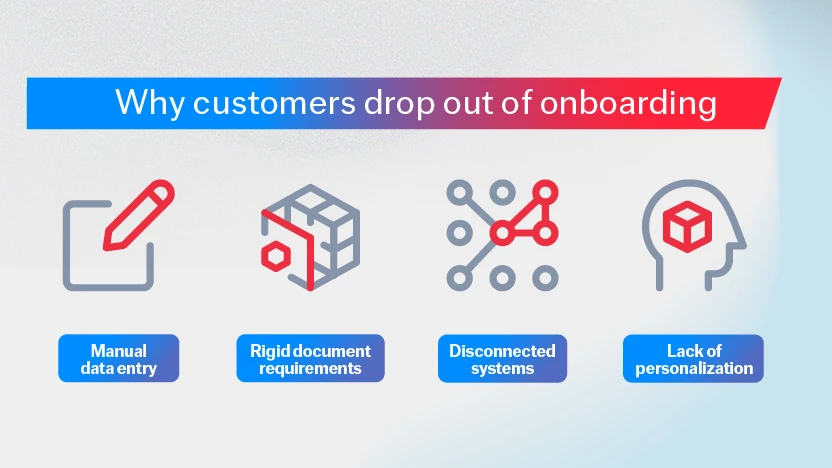
Understanding where and why customers get frustrated during onboarding is the first step toward fixing the process. Most drop-offs come down to a few pain points:
- Manual data entry: Even simple tasks like entering an address can feel burdensome without auto-fill or smart capture to ease the process.
- Rigid document requirements: Customers are often asked to upload or email files in specific formats they don’t have on hand.
- Disconnected systems: When a customer starts the onboarding process on one device, they’re often forced to start over if they switch to another.
- Lack of personalization: Legacy systems usually make every user go through the exact same process. Customers have to fill out forms that don’t apply to them, and low-risk customers get subjected to unnecessarily tough checks.
To keep customers engaged, businesses need automation that goes beyond the basics. That’s what Document AI does. It understands what the information in a document is, where that data belongs in the process, and what the customer needs next.
How Document AI improves the customer onboarding experience
Document AI is intelligent document processing (IDP) technology that can read, understand, and extract information contained in documents. Basically, it turns unstructured data found in documents into structured, contextualized information that business systems can then use.
In customer onboarding, Document AI:
- Automates manual work: Using optical character recognition (OCR), intelligent character recognition (ICR), and AI-based recognition, Document AI automatically captures, extracts, and classifies data from IDs, “proof-of” documents like utility bills, bank statements, and even handwritten or low-quality documents.
- Makes onboarding mobile-first: In the U.S., over 60% of website visits come from smartphones. With Document AI, customers can complete every step of the onboarding process on handheld devices, from taking a photo of an ID to submit proof of address. Progress also gets synced across devices and channels, so customers can start on one platform and finish on another without losing information.
- Delivers real-time information: AI-powered document understanding and facial matching allow companies to confirm identities in seconds and reduce customer wait times. When Document AI is paired with process intelligence, the combination can give teams real-time insight into where customers get stuck and how to improve each step.
- Adapts to context: Because Document AI can understand what each document contains and where it fits in the process, it’s able to route data intelligently and adjust workflows in real time.
- Improves security: Document AI helps verify that documents are genuine by spotting issues like mismatched details or irregular formatting. When paired with broader fraud- and identity-check systems, it keeps onboarding secure and compliant without slowing customers down.
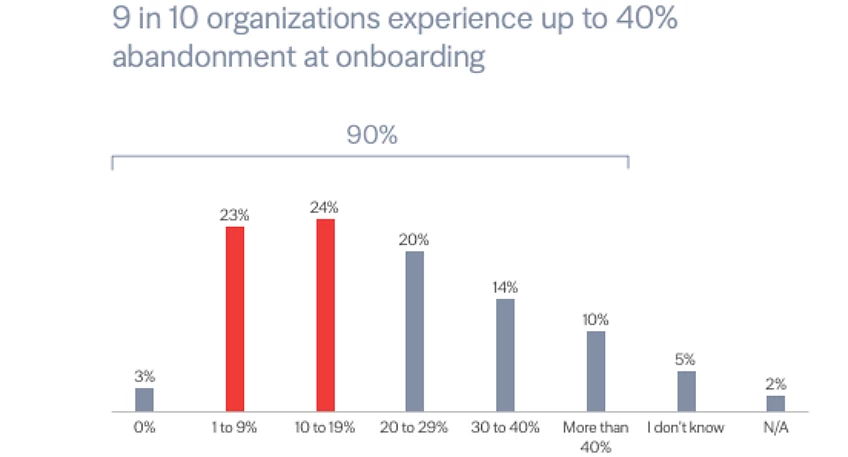
Combined with other technologies, Document AI becomes even more versatile. For example, organizations using chatbots as part of their onboarding process could integrate Document AI so customers can securely upload and process documents within the conversation. All in all, Document AI helps reduce onboarding abandonment rates and keep more customers engaged.
What industries are automating customer onboarding?
Financial services
Banks and financial institutions must meet strict compliance standards without losing customers to slow processes. By automating onboarding, they can verify identities and capture data from supporting documents to follow Know Your Customer and anti-money laundering rules while still opening accounts in minutes.
Transportation and logistics
Transportation companies need to onboard many different audiences, including customers, drivers, vendors, and partners. By using Document AI to capture and validate information automatically from bills of lading and other documents, companies can move faster on processes like driver registration and shipment approvals.
Insurance
Insurance providers are adopting automation to process policy applications and claims with fewer manual checks, giving customers faster decisions and agents more time to focus on customer service instead of paperwork.
Government
In the public sector, agencies are using Document AI to let citizens register for services and benefits. People can renew licenses or verify their identities online without filling out long forms or making a trip to a government office.
Healthcare
Healthcare organizations are simplifying patient onboarding by digitizing intake forms and verifying insurance details instantly. In addition, Document AI improves data accuracy across systems that used to operate in silos.
Success stories across industries
Every industry depends on customers, so every industry can benefit from smarter onboarding. Here are a few real-world examples of how organizations are using Document AI to make onboarding faster and easier:
Energy supplier converts new customers in under three minutes
By connecting Document AI into its mobile site, multi-energy supplier Butagaz made it possible for customers to simply snap a photo of their existing bill to have the system automatically recognize key details, return a quick price estimate, and offer a digital contract to sign.
BPO provider automates millions of customer communications
Paragon Customer Communications used Document AI to automatically capture and categorize incoming documents from multiple channels. The company was to automate 90% of the work of processing over 35 million pages a year.
Insurer broker speeds claims processing
Document AI automatically extracted useful details from claims documents and correspondence for Ecclesia Group, a leading German insurance broker. The data was then routed to the right teams to trigger downstream processes.
Fintech achieves straight-through processing for remittance documents
Sidetrade, a global order-to-cash platform provider, added Document AI to its cash application solution to extract data from remittance documents. The system achieved over 90% accuracy out of the box and now performs straight-through processing.
ABBYY’s approach to intelligent customer onboarding
ABBYY Document AI brings intelligence to every step of the onboarding journey. Our purpose-built AI-driven technology reads and understands documents similar to the way a person would, except much faster and without errors. In the ABBYY Marketplace, we offer pre-trained AI models for processing documents specific to onboarding, such as Identity Document, Bank Statement, and Loan Application.
The result is a smoother experience for both customers and employees. Customers can open accounts, apply for loans, or register for services entirely from their mobile devices. At the same time, organizations gain the confidence that every submission is verified and compliant. ABBYY Document AI can also connect with process intelligence tools to give teams the visibility to see where customers stall, helping them improve the process continuously.
In short, our technology delivers the balance every organization wants: less friction for customers and fewer risks for the business. Schedule a demo to see how ABBYY can transform your onboarding experience.