
Artificial intelligence (AI) is advancing at breakneck speed, capturing attention as a technology with near-limitless potential. However, AI’s true power lies not in the technology alone. It’s in how you put it to work.
AI solutions shouldn’t just impress but truly transform your business from within to conquer real-world challenges. In this post, we explore how AI—especially purpose-built AI—is revolutionizing business process management (BPM) so organizations can thrive.
Jump to:
What is artificial intelligence (AI)?
What is AI in business process management?
What are the benefits of AI-driven business process management?
What is the role of AI in business process management?
What is artificial intelligence (AI)?
Artificial intelligence is a technology that enables machines to mimic human intelligence. Simply put, AI merges computer science with data to tackle complex problems, often doing so faster and more efficiently than humans can.
But AI isn’t just one tool with a single purpose—it’s a broad term that encompasses a number of powerful technologies, including:
- Machine learning, which enables systems to learn from data, identify patterns, and improve performance over time without explicit programming.
- Natural language processing (NLP), which allows computers to understand and respond to human language.
- Deep learning, which applies advanced algorithms to recognize complex patterns to make predictions and enhance decision-making.
- Computer vision, which uses digital systems to process, analyze, and interpret visual data.
- Generative AI, which is capable of learning coding languages and generating new content by simulating human creativity.
Together, these technologies are transforming industries and reshaping how we work and solve problems.
What is AI in business process management?
AI in business process management is the integration of AI into common business processes—like invoicing, employee onboarding, customer service, and data entry—to analyze and optimize workflows. AI-powered BPM can analyze your data in real time, adapt processes, and automate routine tasks faster and more efficiently than traditional methods.
What are the benefits of AI-driven business process management?
AI-driven BPM brings together smart automation with streamlined process management—a combination that helps businesses run smoother and stay ahead of the competition. Important benefits include:
Increased efficiency
AI helps automate a wide range of time-consuming tasks to reduce bottlenecks in business processes. For instance, intelligent document processing (IDP) automates data extraction and processing for even complex documents like invoices and contracts, minimizing manual data entry and accelerating document-heavy workflows. In addition, AI’s real-time data analysis provides you with the insights needed to adjust processes on the fly and stay competitive as conditions evolve.
Improved accuracy
By improving and automating activities that are prone to human error, AI-driven BPM reduces mistakes and ensures data consistency across processes. Solutions like IDP, for example, can extract, interpret, and validate information from unstructured documents at a very high accuracy rate. Additionally, AI-driven BPM can use predictive analytics and machine learning algorithms to flag potential errors or compliance risks before they become problems.
Continuous process improvement
AI-driven BPM allows you to enhance and adapt workflows in real time without constant human involvement. For example, by automatically applying insights from process intelligence, AI-driven BPM can keep workflows running at peak efficiency, dynamically responding to changing demands, resource availability, and disruptions. This constant refinement helps organizations maintain high operational excellence over time.
Workforce empowerment
AI-driven BPM frees your employees to focus on higher-level, strategic work that requires creativity and problem-solving skills. In fact, when no-code AI tools are integrated with BPM, business users can create, modify, and optimize digital processes—even without any coding expertise. This helps reduce dependency on IT, shortening development cycles for rapid deployment of solutions.
Scalability
AI-driven BPM is designed to be highly adaptable. If demand for your product or service suddenly increases, AI-driven BPM can handle additional workflows without requiring extensive adjustments or new infrastructure. No-code tools can add even more flexibility by allowing non-technical staff to modify workflows or create new processes on demand.
What is the role of AI in business process management?
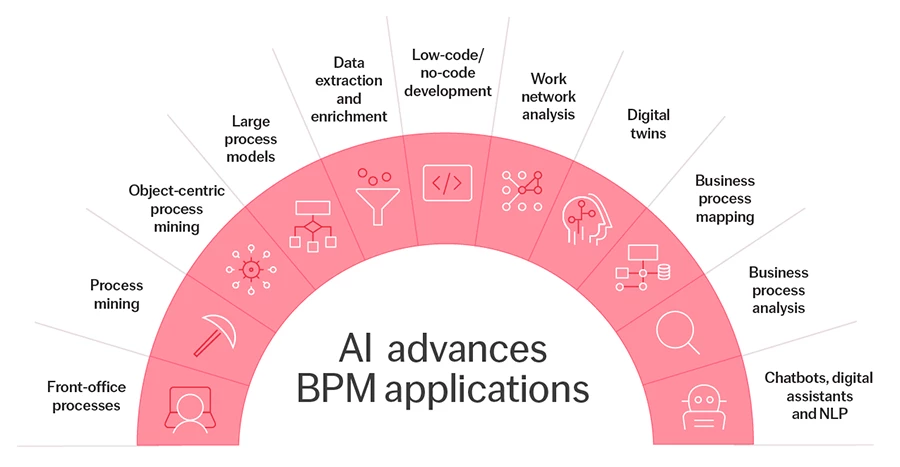
The most important contribution AI makes to BPM is intelligent automation—the ability to automate complex tasks, analyze data, and make real-time adjustments to create a dynamic, continuously improving system.
Automation
AI in BPM takes business automation far beyond basic robotic process automation. For example, AI-powered IDP can accurately extract and process data from complex, unstructured documents like contracts or invoices, then make real-time decisions based on the data, such as re-routing tasks or reallocating resources. This creates smooth, adaptive workflows that free employees to focus on strategic, creative work rather than repetitive data handling.
Data analysis
AI can process vast amounts of data to uncover insights, detect workflow patterns, and identify bottlenecks in BPM. Through process intelligence, AI provides a clear view of process efficiency, highlights areas for improvement, and forecasts outcomes using predictive analytics for smarter, proactive decision-making. AI can, for example, analyze customer service workflows to reveal common delays, allowing managers to adjust and streamline response times.
Process building
With AI in BPM, organizations can analyze data and past performance to recommend optimized workflows, allowing businesses to tailor processes to meet specific needs. When combined with no-code platforms, AI enables non-technical users to create or modify workflows. This makes process building faster, more efficient, and accessible across the organization.
Challenges with traditional business process management that AI addresses
Traditional Business Process Management (BPM) practices face several key challenges that can be addressed by leveraging AI:
- Incomplete or inaccurate process data
BPM relies heavily on accurate data. Incomplete or erroneous data can lead to flawed process maps and models, affecting decision-making. - Lack of process visibility
Without clear visibility into processes, it becomes difficult to identify bottlenecks and inefficiencies. This lack of transparency can impede process optimization. - Lack of process governance
Effective BPM requires strong governance to ensure processes are followed consistently. Without it, processes can become fragmented and ineffective. - Risks of changing complex processes
Modifying complex processes can be risky and may lead to unintended consequences. Careful planning and risk management are essential. - Failure to continuously improve
BPM is not a one-time effort. Continuous improvement is necessary to adapt to changing business environments and maintain process efficiency. - Integration capabilities
Integrating BPM with existing systems and technologies can be challenging. Ensuring seamless integration is crucial for the success of BPM initiatives.
Addressing these challenges requires a strategic approach, including selecting the right tools, ensuring accurate data, fostering organizational buy-in, and maintaining a focus on continuous improvement.
Examples of AI in BPM
Nearly any process can be enhanced by combining AI with BPM. Here are a few key business functions that stand to benefit:
Finance
AI-driven BPM can help finance teams avoid late payments and penalties by analyzing data to identify accounts at risk of becoming delinquent. By providing deeper visibility into large data volumes, AI can also automate tasks like fraud detection, credit scoring, and document analysis, streamlining operations and enabling more strategic focus. In addition, AI-driven BPM can generate predictive insights for continuous process improvement.
Human resources
In HR, AI can streamline salary review processes by analyzing multiple data points—such as employee performance, seniority, budget, and market trends—to support objective decisions on pay increases. Instead of relying solely on spreadsheets and subjective judgment, HR teams can use AI-driven insights to ensure fair and competitive offers for new hires and salary adjustments for existing employees. AI also helps HR by automating administrative tasks, organizing unstructured data, and even identifying attrition trends, allowing HR teams to focus on strategic employee engagement and retention efforts.
Sales
AI-driven BPM streamlines complex sales workflows by automating core tasks, helping teams maintain consistency and focus on building customer relationships. For example, AI can prioritize leads based on the likelihood to convert and recommend the best sales channels for each prospect. AI can also support sales reps by providing prospects with instant answers through chatbots, creating a smoother, more personalized sales journey.
Is your company ready to complement business process management with AI?
ABBYY Timeline offers a powerful solution for advanced BPM, backed by over 35 years of industry experience. With ABBYY Timeline’s process intelligence capabilities, organizations can visualize, analyze, predict, and improve workflows based on real data, identifying inefficiencies and uncovering opportunities for automation. Our platform integrates cutting-edge technologies while avoiding the common pitfalls of generic solutions by fine-tuning purpose-built AI to meet each business’s unique needs. Explore how ABBYY Timeline can empower your organization to achieve continuous improvement and operational excellence.