Back to ABBYY Blog
Prevent Delays That Lead to Abandonment by Enhancing Identity Verification with Intelligent Document Processing
Travis Spangler
September 21, 2023
September 21, 2023

Identity verification is the process of confirming the authenticity and legitimacy of an individual's claimed identity, typically through the examination and validation of official documents, personal information, or biometric data to establish trust and prevent fraudulent activities. It ensures that the person or entity attempting to access a service or engage in a transaction is indeed who they claim to be.
Manual identity verification processes are prone to human error and inefficiency, leading to inaccuracies and delays in verifying identities. Additionally, they can be vulnerable to fraud and impersonation due to the lack of robust automated checks and verification measures, putting both businesses and individuals at risk of financial losses and security breaches.
Intelligent document processing (IDP) solutions, such as from the industry leading vendor ABBYY, employs advanced technologies such as optical character recognition (OCR), natural language processing (NLP), and machine learning (ML) to automate the extraction, interpretation, and processing of data from various documents. By streamlining manual document-related tasks, IDP enhances efficiency, accuracy, and compliance across industries, ranging from data entry to complex document-based workflows, ultimately transforming how organizations establish and confirm individuals' identities.
IDP can enable identity verification by swiftly extracting relevant information from documents like ID cards and passports, then cross-referencing it with databases to validate authenticity. This automation enhances accuracy, speeds up verification, and reduces the risk of human errors in the process.
Commonly used identity verification documents include passports, driver's licenses, and utility bills. IDP employs optical character recognition (OCR) to extract data such as names, addresses, and dates of birth from these documents, allowing for swift automated processing and cross¬ referencing with external databases to verify the provided information.
The typical IDP-based identity verification process involves several key steps. First, the user submits their identity document, such as a passport or driver's license, by using a mobile device to take photos of these documents for the IDP platform, which then utilizes OCR to extract relevant data, such as name, date of birth, and address, from the document. Next, the extracted data is cross-referenced with data from supporting documents or external databases and verification sources to confirm its accuracy and legitimacy. The automated process uses artificial intelligence (AI), NLP, and machine learning to detect potential fraud indicators or discrepancies. Finally, a verification grade is determined, indicating whether the identity has been successfully confirmed, streamlining the overall verification process with enhanced speed, accuracy, and security.
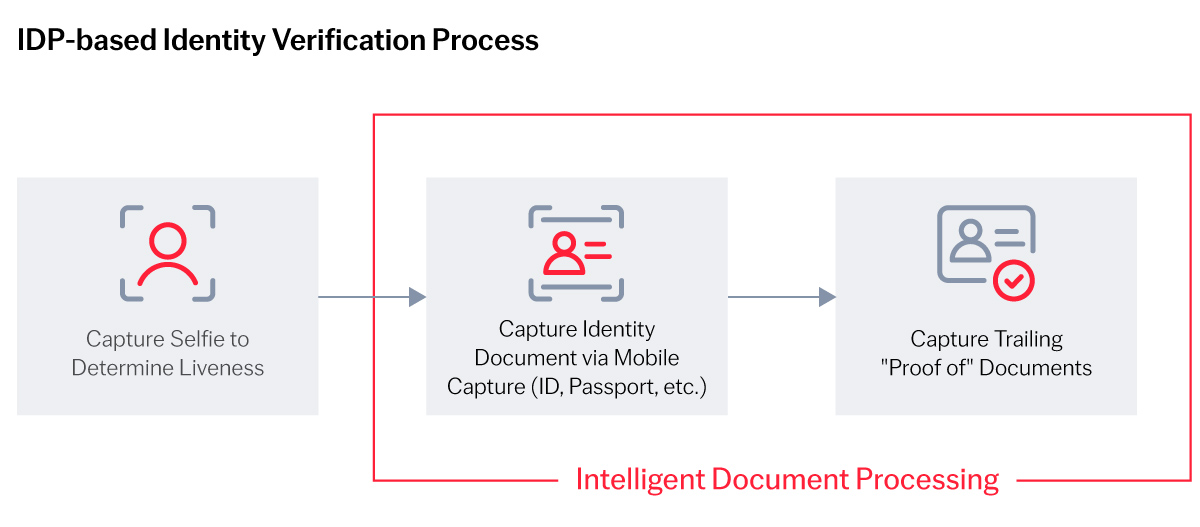 Figure: Typical process flow for IDP-based identity verification.
The ABBYY Proof of Identity solution integrates document-centric identity verification and confirmation into a unified system. The solution ensures user-friendly experience for customers while maintaining robust security measures for your business by utilizing ABBYY's cutting-edge mobile capture and intelligent document processing technologies.
Emerging technologies and trends in IDP are poised to reshape identity verification. Integration with blockchain could enhance security and data traceability, ensuring tamper-proof records of verified identities. Continued advancements in machine learning and AI like NeoML will likely lead to more sophisticated fraud detection algorithms, further bolstering the reliability of automated verification processes. Additionally, the expansion of IDP into new industries and use cases could streamline identity verification across various sectors, from confirming patient identity to meet HIPAA requirements in healthcare to onboarding new customers for digital account opening in banking.
Adopting intelligent document processing (IDP) solutions can significantly enhance your identity verification workflows. By automating tasks such as data extraction, cross-referencing, and fraud detection, IDP reduces errors and speeds up verification, leading to improved efficiency and client satisfaction. Incorporating cutting-edge technologies like OCR and machine learning guarantees a higher level of precision, mitigating the risks linked with manual verification. Embracing IDP not only simplifies operations but also reinforces security measures, protecting your business and customers against potential fraud and identity theft. Tap into the potential of IDP to transform your identity verification procedures, ensuring smoother processes and a sense of security for both your team and clientele.

Travis Spangler
Director of Sales and Operations Company at UFC Inc.
Travis Spangler, the Director of Sales and Operations at UFC Inc., has expertise in Intelligent Document Processing (IDP), Artificial Intelligent / Machine Learning, Identity Verification, and Process Mining. With unwavering dedication to clients, Travis leads UFC Inc. as a premier value added reseller of ABBYY (the industry-leading IDP and Process Mining vendor).