In today's data-driven world, organizations are continually seeking ways to utilize their business information to make better decisions, optimize operations, and gain a competitive advantage. Two key technologies have emerged in the pursuit of quantifying and understanding intricate business processes, often likened to the central nervous system of any operation: business intelligence (BI) and process intelligence (PI).
While many are familiar with BI platforms for its visualization of data analysis insights, PI is a newer concept rapidly gaining traction as it can pinpoint near real-time process execution and provide insights that enhance all processes, including RPA. Discover how process intelligence, starting with process mining, leads to remarkable improvements in operational efficiency, cost savings, informed strategic decisions, and business excellence that deliver on customer expectations.
Process intelligence is a collection of new data science approaches that focus on the analysis and optimization of business processes across all systems and applications involved end to end.
Sometimes referred to as a new generation of process analytics, process intelligence solutions go beyond traditional process mining. A process intelligence (PI) platform consists of the following core capabilities:
- Process mining uses actual data from information systems to create a model that accurately reflects how a process executes. It consists of event logs, audit trails, or any other records representing “breadcrumbs”.
- Task mining involves capturing and analyzing user interactions with desktop applications to perform tasks related to higher-level process execution. This is especially valuable when event logs or audit trails lack granular details about specific process steps.
- Process analytics is a tool designed specifically for interpreting multistep process data. This enables how different process execution patterns correlate to specific process characteristics and is instrumental in identifying bottlenecks, inefficiencies, compliance lapses, and opportunities for improvements.
- Process monitoring is an automation-driven monitoring of ongoing business process instances, aiming to quickly detect any deviations from expected behavior. This tool includes the ability to notify users or trigger actions in related environments in response to identified deviations.
- Process prediction is an artificial-intelligence-based approach to predict future outcomes by analyzing all possible variations of previous process instances.
- Process simulation empowers organizations to build “What if?” scenarios to test the potential impact of changes in process definitions or resource allocations, so you can assess the effectiveness of process optimization decisions, before committing time and resources to these changes.
When we explore the 'Order to Cash' process through the lens of PI, the focus shifts to a comprehensive understanding of all the variations and patterns within the processes end to end, including the implications of delayed or missed steps, impact of the process sequencing, and or the contributions of various individuals in specific instances in the process.
For example, process intelligence might reveal that a particular step in the process, such as order verification, is taking too long and subsequently causing delays that ripple throughout the process. Or PI might expose instances where crucial steps like credit checks are skipped, resulting in increased financial risk for the organization. Process intelligence provides a holistic perspective and can unveil critical insights into process dynamics and optimizations opportunities.
Business intelligence, on the other hand, is a technology-driven process that involves the analysis and presentation of business information. The primary goal of BI is to help organizations make informed decisions by providing insights into their business operations, customer behavior, market trends, and competitive landscape.
From the analyst’s perspective, the most important elements of BI are:
- Data analysis: Analyzing the data to identify patterns, trends, and anomalies.
- Data visualization: Presenting the analyzed data in a visually accessible manner, such as dashboards, charts, and reports.
When we review the 'Order to Cash' process with BI tools, there are numerous ways to analyze how many new orders were received today or the breakdown of the orders based on salesperson, product family, geography, etc. Using these capabilities, an analyst might analyze the number of new orders received broken down by day for the last month, the most popular product families and how that may have changed over time, the regions with the highest sales stack ranked, or the salespersons with the highest order intake.
What BI cannot tell you, at least without a huge amount of custom development and complex SQL or related programming, is how those metrics were impacted by the execution of other parts of the process.
For instance, can you determine if instances where certain salespersons received the highest number of orders coincided with efficient customer interactions where inquiries were promptly addressed; and conversely, can you determine if low order rates correlated to slow response times or potentially overlooked customer inquiries, ignoring the attempt completely? This is where BI falls short as it’s unable to establish and reveal those connections.
Focus
Process intelligence focuses on the analysis and optimization of business processes, looking at the entire process lifecycle. Business intelligence focuses on providing in-depth analysis of individual process steps.
Data sources
Process intelligence uses event logs, audit tables, user interactions, and desktop activities as primary data sources. Business intelligence uses data from various sources related to a specific step/portion of a business process in order to analyze and visualize patterns, trends, and anomalies.
Outcomes
Process intelligence provides insights that help organizations optimize their business processes, offering greater understanding of the global context of specific steps and variations between process instances. Business intelligence provides insights that help organizations make informed, data-driven decisions.
Tools
Process intelligence tools include process mining, task mining, analytics, monitoring, prediction, and simulation capabilities. Business intelligence tools typically include dashboards, reports, data analysis, and other visualization capabilities.
Process intelligence and business intelligence do have similarities: both use organizational data to visually represent insights that support business management, analyzation, and decision-making processes. The same data warehouses may be leveraged in both process intelligence and BI tools, however the insights provided will vary depending on each platform's capabilities and limitations. This knowledge is fundamental for first-year business school students and professionals alike, as it forms the foundation for making informed decisions and optimizing business operations in a data-driven world.
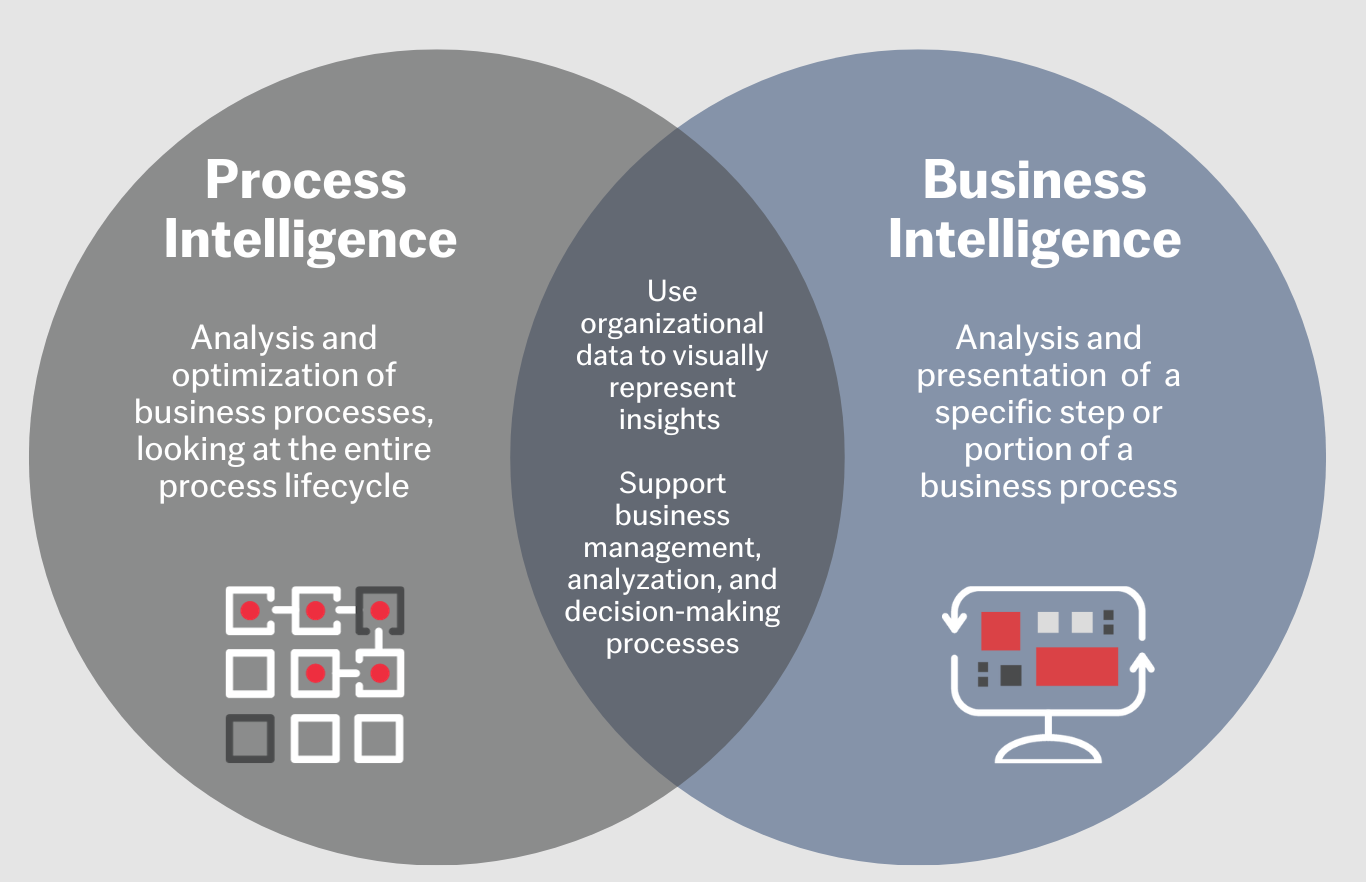
While business intelligence and process intelligence may seem similar initially, they serve different purposes in observing and analyzing an organization's operations. BI provides insights on individual process steps, one by one, allowing for detailed analysis of conventional dimensional breakdowns, while PI provides a comprehensive understanding of business processes and insights for impactful improvements.
It is important for those new to process intelligence and process mining to understand that while BI and PI may seem similar, they are very different in their abilities and focus. Both are essential for organizations looking to improve their operations and gain a competitive edge. Understanding the key differences between BI and PI is crucial for selecting the right tools and approaches to meet your organization's goals.
To see how process intelligence can put your data to work for actionable insights, contact us via this form or join us for a lively discussion in an upcoming webinar.