METRO AG’s Invoice Automation Transformation
- Achieved up to 90% faster invoice processing cycles across operations.
- Reduced invoice processing time from 2 days to 1 hour.
- Scaled seamlessly across multiple regions and business units.
April 25, 2025
With over 35 years of innovation in IDP, ABBYY is a proven leader in the space and recognized by 10 analyst firms. With 1.5 billion invoices processed every year, our AI-driven technology—including machine learning and natural language processing—delivers up to 91% reduction in invoice processing costs.
Key differences include:
Companies using ABBYY intelligent document processing see up to 90% faster invoice processing times, reducing payment cycles from 1-2 days to under an hour. By eliminating manual data entry, automation also frees employees to focus on higher-value tasks. Employee productivity can go up by 400%, with employees spending 30% less time responding to queries.
Yes. Beyond saving time and money through improved productivity and efficiency, automation helps enforce compliance with company policies, vendor agreements, and regulatory requirements. Automated systems are also better at extracting meaningful insights from invoices to analyze trends and make informed decisions.
Because automation takes care of repetitive tasks, employee job satisfaction tends to also go up. Customers benefit too. Faster invoice processing reduces response times, speeding decision-making and payments.
Invoice processing once meant hours spent manually sorting, verifying, and keying in numbers—then chasing down approvals across departments. Today, automation often does the heavy lifting. Invoice automation can capture, extract, and validate key data, then send that information directly to business systems for straight-through processing.
In this guide, we’ll look at how automated invoice processing works, what its key benefits are, and how you can choose the right processing solution for your business.
Jump to:
What is automated invoice processing?
Benefits of automated invoice processing
How to automate invoice processing
How to choose the right invoice automation software
Automated invoice processing is the use of software to capture, extract, validate, and integrate invoice data into business processes.
Without automation, businesses typically rely on staff to manually enter data, verify details, route approvals, process payments, and organize records for future reference—all of which can be time-consuming and error-prone. Automation speeds up the process by performing tasks such as:
A key technology used in automated invoice processing is optical character recognition (OCR), which extracts key details—such as vendor names, invoice numbers, dates, line items, and totals—from invoices without requiring manual data entry.
When combined with AI technologies such as machine learning (ML) and natural language processing (NLP), automated invoice processing gets smarter to efficiently process even unstructured PDFs and handwritten receipts—whether they arrive via paper, email, API, mobile, or scanning. ML enables the system to identify patterns and continuously improve accuracy by learning from past corrections, while NLP helps understand context and adapt to new formats without manual intervention.
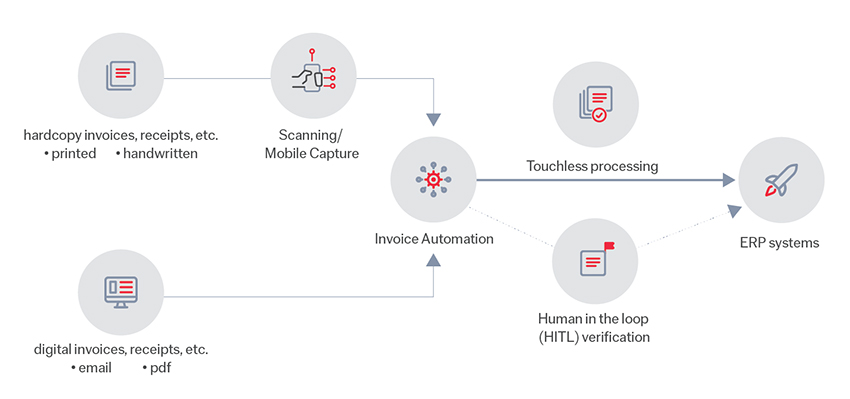
The exact workflow of automated invoice processing depends on the solution you choose. Intelligent document processing (IDP) solutions powered by AI, for example, can go beyond basic, rule-based automation to handle more complex tasks and continuously improve accuracy. These solutions deliver the data to the company’s information systems such as RPA, BPM, and ERP to facilitate straight-through processing of invoices. No matter the channel that invoices arrive—paper, email, API, MFP/local scanning, mobile device, web-based scanning—all invoices are processed centrally. Here’s how the process typically works:
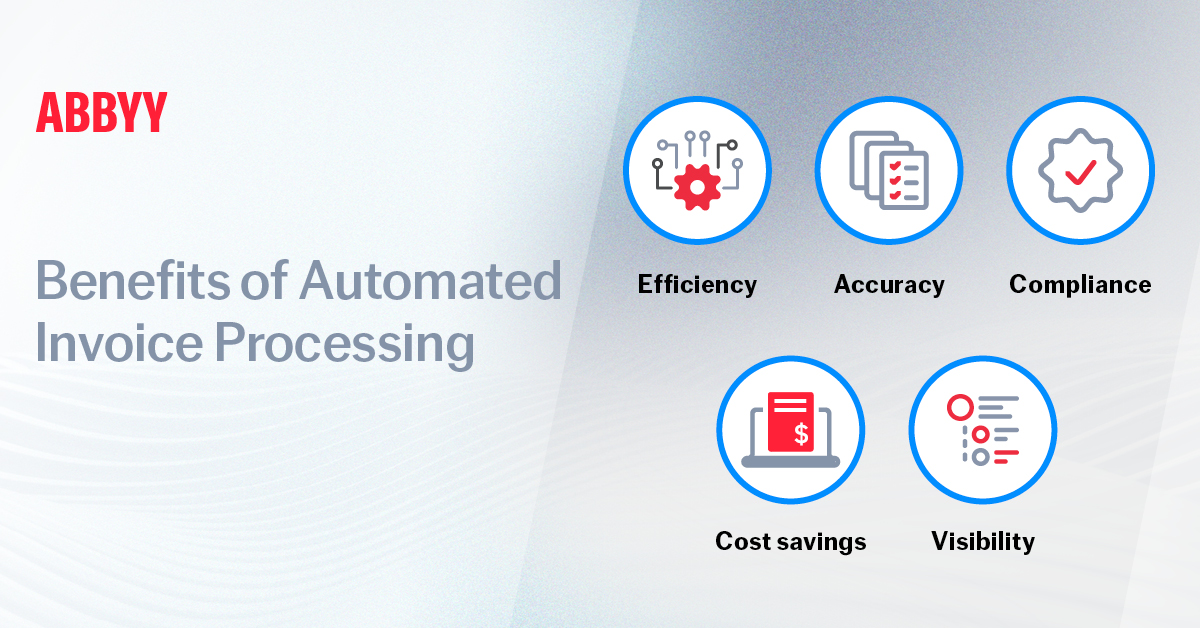
Automation improves invoice processing not just by speeding up and streamlining your workflows, but by giving you stronger financial controls and better oversight. Advantages include:
Automating invoice processing eliminates unnecessary steps, reduces bottlenecks, standardizes processes, and streamlines decision-making for a faster, more consistent workflow with less friction. Invoice records can be easily centralized for quicker access and stronger security. Streamlining accounts also involves identifying and eliminating potential sources of errors, while standardizing processes ensures that tasks are carried out in a consistent manner.
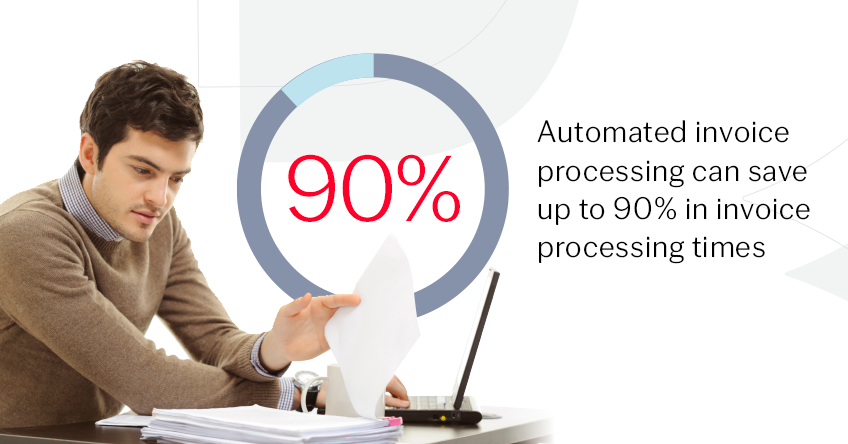
With AI-powered automated invoice processing, companies can see as much as a 90% improvement in invoice processing times, with straight-through processing reducing tasks that once took a day or two to under an hour. Employee productivity also goes up by as much as 400%, and accounts staff spend 30% less time on queries, freeing them to focus on higher-value tasks.
Humans often make mistakes when repetitively reading, entering, or verifying data. Automating invoice processing eliminates this risk. With three-way matching, the system automatically cross-checks the purchase order, goods received report, and invoice for quantity and pricing—preventing overpayments, underpayments, late or duplicate payments, and other mistakes while improving consistency and efficiency.
Automated invoice processing enforces approval workflows, maintains a clear audit trail, and validates invoices to reduce fraud and errors. By processing invoices according to company policies and regulatory standards, it helps businesses meet tax, financial, and industry compliance requirements while minimizing penalties.
Cost savings are a key driver for switching to automated invoice processing, with businesses seeing up to 91% lower processing costs. Recent surveys suggest that the median AP cost per invoice is $11, while best-in-class companies spend just $3 or less per invoice. Invoice automation also helps organizations save money by helping them take advantage of early payment discounts.
Automation provides real-time tracking and reporting on the status of invoices so businesses can keep track of outstanding payments, forecast expenses, and make more informed financial decisions.
Choose a turnkey automated invoice processing solution that captures, recognizes, extracts, and validates data to make straight-through processing of PO-based invoices easy and accurate.
Be strategic when designing the steps and decisions involved in your invoice processing workflow. Customize and configure your process to match the unique requirements, preferences, and constraints of your organization.
Leading invoice processing software providers offer free connectors for fast, low-cost integration with top enterprise resource planning (ERP) and accounting systems. Integrate your invoice automation solution with your existing infrastructure so that extracted and verified invoice data is delivered directly to your existing systems—including robotic process automation (RPA), customer relationship management (CRM), business process management (BPM), enterprise content management (ECM), and accounting platforms—creating a smarter, end-to-end automated accounts payable workflow.
Test customized workflows in a controlled environment, gather feedback, and make necessary adjustments. As business needs evolve, continuously monitor the workflow's performance to analyze its effectiveness and make further optimizations to stay relevant and effective.
Selecting the right invoice automation software for your business is central to improving efficiency and accuracy. Here’s what to look for when evaluating your options:
ABBYY’s industry-leading AI-powered invoice processing software delivers speed, accuracy, and efficiency at scale, offering:
That combination of advantages translates to real results for ABBYY clients. Take GEMLUX, a leading marine hardware manufacturer. Before automation, the company’s manual purchase order processing required sales reps to spend 30–45 minutes entering POs—some with more than 100 line items—while consolidating supplier orders could take an entire day. By integrating ABBYY intelligent document processing (IDP) with NetSuite ERP, GEMLUX reduced PO processing to just 3–5 minutes. Supplier order management became 75% faster too. With ABBYY IDP in place, GEMLUX is now expanding automation to other document workflows.
Every company has unique challenges, and ABBYY’s purpose-built AI solution adapts to different needs with pre-trained models tailored to specific industries. If you’re ready to see how ABBYY can optimize your invoice processing, request a demo with one of our experts today.
To automate billing processes, businesses typically follow these four steps:
AI-powered automated invoice processing combines the power of automation with the intelligence and adaptability of AI. Take OCR, for example. Traditional OCR simply converts scanned text into machine-readable text without understanding the context. However, when combined with AI technologies like machine learning (ML) and natural language processing (NLP), OCR can intelligently extract, classify, and validate data, improving accuracy and adaptability for complex documents.
In short, AI-powered automated invoice processing goes beyond eliminating manual data entry, to handle more complex tasks like cross-checking, validation, and automated routing, with integrations to ERP, RPA, and accounting systems for end-to-end automation.

Maxime Vermeir
Senior Director of AI Strategy
With a decade of experience in product and technology, Maxime Vermeir is an entrepreneurial professional with a passion for creating exceptional customer experiences. As a leader, he has managed global teams of innovation consultants and led large enterprises' transformation initiatives. Creating insights into new technologies and how they can drive higher customer value is a key point in Maxime’s array of Subject Matter Expertise. He is a trusted advisor and thought leader in his field, guiding market awareness for ABBYY's technologies.
Connect with Max on LinkedIn.
Available on YouTube and Spotify, this series covers a wide range of topics, all related to artificial intelligence and intelligent automation for business and technology leaders.
Please enjoy! https://linktr.ee/AIPulsePodcast
