From unstructured documents to automated decisions: IDP + LLM workflow
- Prevents hallucinations with verified data
- Classifies and extracts first, reasons second
- Keeps every AI output traceable
- cales from extraction to full reasoning
October 25, 2024
The roots of Intelligent document processing (IDP) can be traced all the way back to the early days of optical character recognition (OCR) solutions—tools that converted character images into digital text computers could understand. Today’s IDP solutions go far beyond that, using artificial intelligence (AI) and some of the most cutting-edge technology available to analyze all types of data from any kind of document—structured, semi-structured, or unstructured—for just about any process in any industry.
This blog post answers your most frequently asked questions about IDP, explaining how it works, and showcasing the many practical applications. Plus, we’ll provide insights on how you can harness IDP to transform your business.
Jump to:
What is intelligent document processing (IDP)?
What are the benefits of intelligent document processing?
How does intelligent document processing work?
Intelligent document processing use cases
How has intelligent document processing evolved?
How to choose the right intelligent document processing software
Master your data and processes with the leader in intelligent document processing
Intelligent document processing (IDP) uses AI and machine learning to read, extract, and organize data from any document, making it usable for your business.
IDP works with any document type and format (structured, semi-structured, and unstructured) to process content in documents like a human.
Over the years, IDP technology has evolved to incorporate smarter features, such as natural language processing (NLP), which enabled computers to go beyond simple character recognition to understanding the meaning of words and sentences of the text being converted. Despite these advancements, IDP for a long time was mostly confined to back-office tasks like handling mail or business process outsourcing (BPO) functions, isolated from revenue-critical interactions with customers, suppliers, and employees.
Today, IDP is evolving quickly. Modern intelligent document processing technology now extends beyond just data extraction. It reimagines how content is used as part of customer and employee experiences, using advanced, AI-based document processing models to make information immediately available and actionable exactly when and where it's needed.
Learn more about ABBYY's low-code / no-code IDP solution
Across all industries, businesses are facing pressure to do more—and do it faster—with fewer skilled resources. At the same time, more organizations are focusing on improving experiences for customers and employees as a key to improving revenue, margins, and retention. Intelligent document processing (IDP) can deliver significant benefits on both counts. By applying document skills in a way that closely supports the way humans understand and manage content, IDP provides the following benefits:
To truly grasp the power and potential of intelligent document processing, it's helpful to clarify what it's not, as well as what it is:
Let's break down the journey of a document through intelligent document processing.
IDP begins with document input. In this step, the documents that come into your business via different systems and formats—handwritten notes, emails, faxes, photos, and more—are automatically collected.
Next, powerful tools like optical character recognition (OCR) convert all the information in your documents into machine-readable text. Files may be split up or pre-processed to improve image quality, as needed.
Then comes document classification. IDP identifies and categorizes your documents by type based on their content and context. Using natural language processing (NLP), it reads the text and interprets its meaning. For example, If it encounters the word “jaguar,” IDP uses contextual clues from the surrounding text to figure out whether the word refers to a large cat or a car. Similarly, if IDP sees the word “Sue,” it will analyze the surrounding keywords and phrases, using the context to figure out whether the word refers to a person’s name or a legal action.
By leveraging NLP, IDP mimics human-like comprehension, quickly adapting to changing inputs to interpret and extract a remarkably high percentage of unstructured data. This ensures the most accurate classification, with everything placed exactly where it belongs.
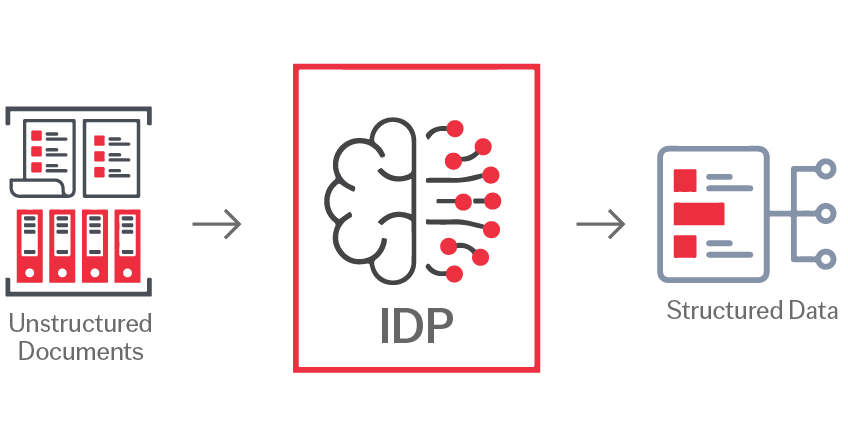
After your documents are classified, data extraction begins. Here, IDP applies FastML technology, a client-side learning mechanism that improves how data is pulled from documents. FastML works by analyzing both the visual elements and the text itself to capture information more accurately. This dual approach allows IDP to adapt to different document types, layouts, and languages.
With this technology, businesses can automate time-consuming tasks, freeing up human workers to focus on higher-value tasks. Instead of spending time on manual data entry or document processing, employees can engage in more rewarding work that improves customer experiences and drives business growth.
The versatility of intelligent document processing applications means documents of any language, any format and at any time can be utilized in intelligent automation solutions. We’ll explore four use cases in insurance, customer onboarding/KYC, logistics, loan processing to show examples of how IDP can radically improve organizational efficiency.
Intelligent document processing in insurance is revolutionizing how claims are handled and customer service is delivered. For example, IDP empowers hands-free claims processing, automatically handling straightforward claims without any human intervention. IDP can also power smart, digital self-service options, allowing customers to get answers to their questions without going through a call center. And by taking care of mundane tasks, IDP frees up your employees to focus on empathy and better customer experience.
Take Ecclesia Group, for example. This multinational insurance broker used ABBYY's IDP solution to digitize, streamline, and improve customer correspondence management. Now, IDP automatically extracts critical data like case numbers and license plates from claims documents, matches the information to the right customer, and sends the documents to the appropriate claims manager for further processing.
Intelligent document processing in financial services is transforming document processes in customer onboarding, KYC compliance, trade finance, and more. Take mortgage application processing, for example. Mortgage applications come with a mountain of paperwork, with a typical loan folder running from 100 to 200 pages. Information required can include driver’s license, birth certificate, proof of address, utility bills, bank statements, and pay slips. Intelligent document processing can streamline the whole application and approval process by automatically capturing, reading, understanding, and validating the information within each document to verify the data is correct and genuine. This speeds up loan approvals and offers a more convenient customer experience by letting people apply online or on their phones.
IDP even helps banks scale to handle big surges in applications, which often happen during economic downturns. During the pandemic, for example, banks in Spain were flooded with a staggering 20 million pages—at times more than 100,000 a day—of documents from customers asking for loans. Serimag, a leading process automation company for the banking industry in Spain, made great use of ABBYY’s IDP platform to extract text quickly and accurately from millions of loan applications. The company achieved 75% automation of the whole process, completing the project in under six weeks during lockdown while ensuring more than 99% accuracy to meet its service level agreements (SLAs).
Healthcare organizations are facing enormous pressure to optimize service utilization, improve revenue management, and reduce costs. A growing number of healthcare providers are turning to intelligent automation to streamline processes and extract actionable business insights from their data-driven processes. Intelligent document processing in healthcare helps them achieve this by providing instant access to process-critical data from their documents to support smarter, faster decision-making.
The U.S. Food and Drug Administration used ABBYY IDP to expedite the processing of forms reporting adverse events from drugs—and better protect public health as a result. ABBYY’s AI-powered IDP platform delivered 99% accuracy capturing critical details and delivering them to the appropriate parties.
Mistakes in paperwork can stop a shipment in its tracks and lead to major delays in the delivery of essential goods. Intelligent document processing in transportation and logistics brings accuracy and operational efficiency by automatically handling a whole host of shipping documents such as customs declaration forms, delivery receipts, bills of lading, and driver logs–anytime, anywhere.
Global logistics company Deutsche Post DHL Group saw impressive results when they used ABBYY’s IDP to automate its finance department. The company, which generated USD 100 billion in 2022, previously had a highly manual accounts system for processing hundreds of thousands of invoices annually. But with IDP, the company was able to automatically process invoices in different languages from 124 different vendors, reducing errors and increasing productivity. The company then rolled out the IDP automation project to other departments, ultimately achieving an incredible 70% increase in efficiency.
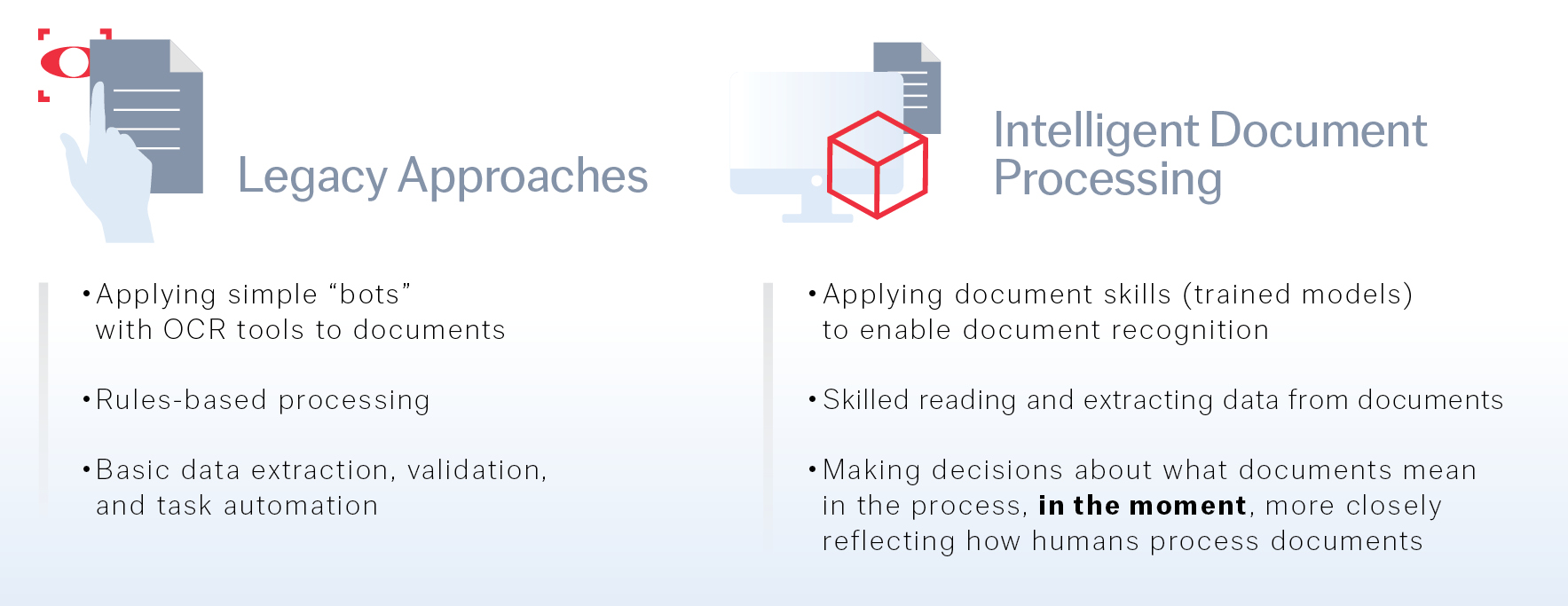
Before intelligent document processing, managing the influx of documents was a laborious, error-prone endeavor. Manual data entry and paper-based processes led to bottlenecks and costly mistakes. Legacy OCR solutions offered some relief, but lacked the intelligence to truly understand and extract meaningful information. Companies were left grappling with large amounts of unstructured data, struggling to keep up with fast-paced business demands.
IDP, combining the power of advanced OCR and AI, changed that status quo. By incorporating machine learning and NLP, IDP solutions can now not only extract data but also understand context, classify documents, and make intelligent decisions. This is a big leap forward that ushers in a new era of accuracy and efficiency.
What’s next for IDP? The future of intelligent document processing is set to revolutionize how businesses and IT professionals handle vast amounts of data, delivering even greater value to businesses through:
With so much hype around AI and an ever-evolving technology landscape, choosing the right intelligent document processing software is vital. Here are a few crucial points to guide you toward the optimal solution for your digital transformation.
Intelligent document processing offers businesses a host of bottom-line advantages, but to unlock its full potential, it needs to be implemented strategically. By first using process mining to understand the current workflows in your business, companies can maximize the advantages of IDP, such as reduced costs, increased efficiency, regulatory compliance, and enhanced employee and customer experiences.
ABBYY's market-leading technologies, delivered in a user-friendly low-code/no-code platform, ABBYY Vantage, the intelligent document processing platform designed for today’s digital workforce.
Over the years, we at ABBYY have learned that our customers are looking for ease of use, quick start, and rapid ROI when it comes to investing in IDP. That’s why we introduced ABBYY Marketplace, an online digital community where you can download ready-made document models and other valuable tools that enhance ABBYY’s IDP platform.
With Vantage, you can easily train and customize your document models without expertise in OCR or machine learning. Human review is built into the process, feeding continuous online learning to improve your models. The key to scaling this solution across different areas of your business is its ability to adapt to various document types and formats.
Ready to accelerate digital transformation and change the way you automate document processes? Get in touch with us today to learn how we can help your business implement a seamless IDP solution tailored to your needs.
The difference between IDP and OCR lies in their capabilities and the way they handle document data.
OCR is a long-established data capture technology that extracts text from paper documents, scanned images, or photographs and converts it into editable digital text. The technology is commonly used to digitize printed documents to make them accessible electronically, like on webpages or in databases. However, while OCR can recognize and convert characters, it doesn’t understand the meaning or context of the text; it simply identifies the characters on the page.
IDP, on the other hand, goes beyond text recognition. IDP not only uses OCR for character recognition but incorporates advanced technologies like AI and machine learning to read, understand, categorize, and make decisions on documents. For example, IDP can read an invoice, compare its content to a corresponding purchase order, cross-check the sums for accuracy, and then forward it to the right person for payment.
Put simply, ADP is far less clever than IDP. ADP can handle routine and repetitive tasks associated with documents, such as sorting them alphabetically and extracting information. However, it typically takes a rules-based approach and is best with structured documents that have the same layout. That means it may struggle with unstructured or semi-structured documents where the content or design varies. It also can’t adapt and learn from previous content it has come across.
In contrast, intelligent document processing uses AI and machine learning to handle more complex and diverse documents, adapting to various document layouts, structures, and content, adjusting as needed. It adds cognitive capabilities that allow it to “think” like a human. When it comes across nuances or irregularities, it knows how to respond and continuously improves by learning from any mistakes. This makes IDP ideal for processing unstructured data for businesses with a wide range of evolving document types.
Both IDP and RPA aim to automate business processes, but have different focuses and capabilities. IDP uses AI to interpret and extract data from unstructured or semi-structured documents, adapting to complex formats. RPA, on the other hand, is designed to automate routine, repetitive tasks in business processes like entering data, retrieving information, and updating records across various systems.
Put simply, while IDP handles data extraction from documents, RPA automates repetitive tasks. The two complement each other by automating different parts of business workflows.
A legacy software for automating repetitive and simple business processes, RPA, or robotic process automation, is often referred to as the “swivel chair” approach to automation: it can complete basic tasks like inputting data, capturing data, validating information, and making updates to documents.
What RPA lacks, however, is the brain to understand the information it is working with and put it into context. That’s where IDP comes in.
Intelligent document processing gives RPA the cognitive skills to make sense of the data it reads. This combination unlocks vital information for companies to make better business decisions. Together, IDP and RPA increase the accuracy of data extraction, improve straight-through processing rates, and reduce the need for manual intervention, ultimately driving operational excellence and business growth.
Yes. IDP and process mining form a powerful combination. The content in your documents, like invoices or customer applications, doesn’t exist in a vacuum—it's an integral part of how your business runs. Simply adding IDP to old-fashioned, legacy processes can yield limited results at best, mainly because these processes weren’t designed for automation. To truly benefit from IDP, you need optimized digital processes, and that’s where process mining comes in.
Process mining extracts timestamp data from your information systems and applies AI to create a visual model of your processes from start to finish—including all deviations from the norm. You can clearly see how your processes move, where they get stuck, and what decisions are made based on them. This helps you identify inefficiencies, pinpoint where IDP can make the biggest difference, and make smart decisions about automation.
Together, IDP and process mining allow you to:
Any organization that handles a lot of paperwork and data can benefit from intelligent document processing. For one, IDP reduces manual, repetitive, and mundane work, improves accuracy, and enhances productivity. More importantly, IDP unlocks the important information in your documents. Consider this: An estimated 80-90% of business data is in unstructured documents that aren’t neatly organized. As a result, many companies are unable to use most of their data and lose out on potential income. IDP unlocks this information and makes it useful.
This technology is making a big impact across industries. In banking, IDP streamlines loan applications. In healthcare, it helps manage patient records and insurance claims. In logistics, it saves millions by automating tasks like order processing and deliveries. Even government agencies are using IDP to speed up the processing of driving permits and social security payments. In fact, across all industries, accounts payable departments are seeing huge time and cost savings with IDP, thanks to straight-through processing rates of up to 90% that free up employees for more meaningful work.
Editorial note: This blog post was originally published on December 8, 2021, and updated on October 25, 2024, to reflect a clarified definition of what is intelligent document processing, how it differs from generative AI models such as ChatGPT, and four modern IDP use cases that showcase our customer's digital transformation journey.

Maxime Vermeir
Senior Director of AI Strategy
With a decade of experience in product and technology, Maxime Vermeir is an entrepreneurial professional with a passion for creating exceptional customer experiences. As a leader, he has managed global teams of innovation consultants and led large enterprises' transformation initiatives. Creating insights into new technologies and how they can drive higher customer value is a key point in Maxime’s array of Subject Matter Expertise. He is a trusted advisor and thought leader in his field, guiding market awareness for ABBYY's technologies.
Connect with Max on LinkedIn.
